What full-mouth implants are
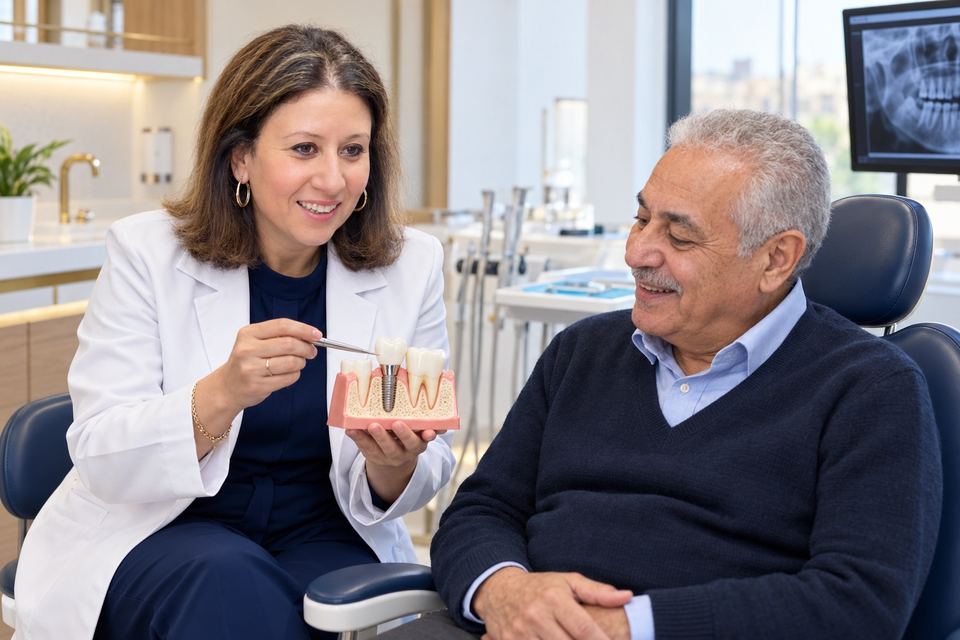
Full-mouth implants, also called full-arch implants, replace all the teeth in one jaw with a single fixed bridge of around 10 to 12 teeth. The bridge is screwed onto a small number of implants, typically 4 to 6 per jaw. You do not take it out to clean it or to sleep; only the dentist removes it, usually during maintenance visits.
You will often hear the names All-on-4 and All-on-6. Both describe the same idea. In an All-on-4 style design, the two back implants are usually tilted so they can avoid the sinus in the upper jaw or the nerve in the lower jaw and still support a long bridge, often without bone grafting. An All-on-6 style design spreads the load over more implants and leaves a spare if one ever has a problem, but needs more bone. Which suits you depends on your scan, not on a brand name; we explain the trade-offs in All-on-4 vs All-on-6.
Who full-arch implants are for
- People who have already lost all their teeth in one or both jaws and want something fixed instead of a denture.
- People with failing dentition: many teeth loose from advanced gum disease, broken down by decay, or repeatedly failing despite treatment.
- Long-term denture wearers who struggle with a loose lower denture, gagging from an upper denture, or sore spots that never settle.
- Patients who can commit to careful daily cleaning and regular professional maintenance.
Designing the teeth first: the prosthodontic approach
A full-arch bridge is as much a facial treatment as a dental one. It sets how your lips are supported, how much tooth shows when you smile, the height of your lower face and how you pronounce certain sounds. Prof. Nouran Abdel Nabi approaches it as a prosthodontist: we design the final teeth first, and only then decide how many implants are needed and where.
That design work typically includes photographs, measurements of your bite and face, and either a digital smile design or trial teeth set in wax that you can see and approve. It also answers a critical practical question: where will the junction between the bridge and your gum sit? If that line shows when you smile broadly, the result can look artificial, so some bone may need to be reshaped during surgery to hide it.
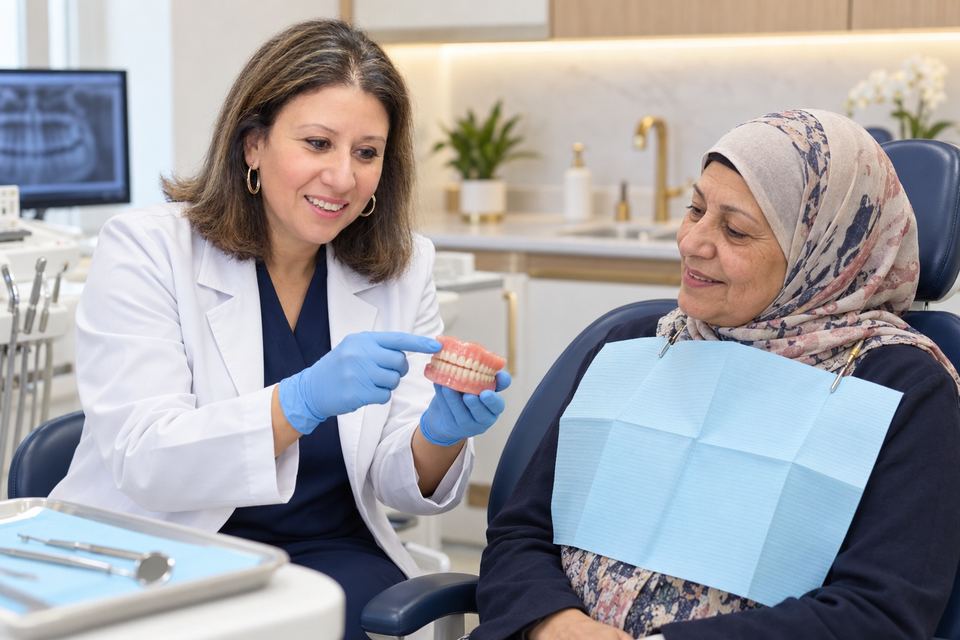
The same assessment sometimes tells us that a fixed bridge is not the ideal answer. If you have lost a great deal of bone and need significant lip support, a removable implant-retained overdenture can give better facial support, be easier to clean, and cost considerably less. We will show you both options when both are reasonable.
Full-mouth implant treatment, step by step
- Consultation and records. Examination, photographs, bite records, and a discussion of your medical history, expectations and budget.
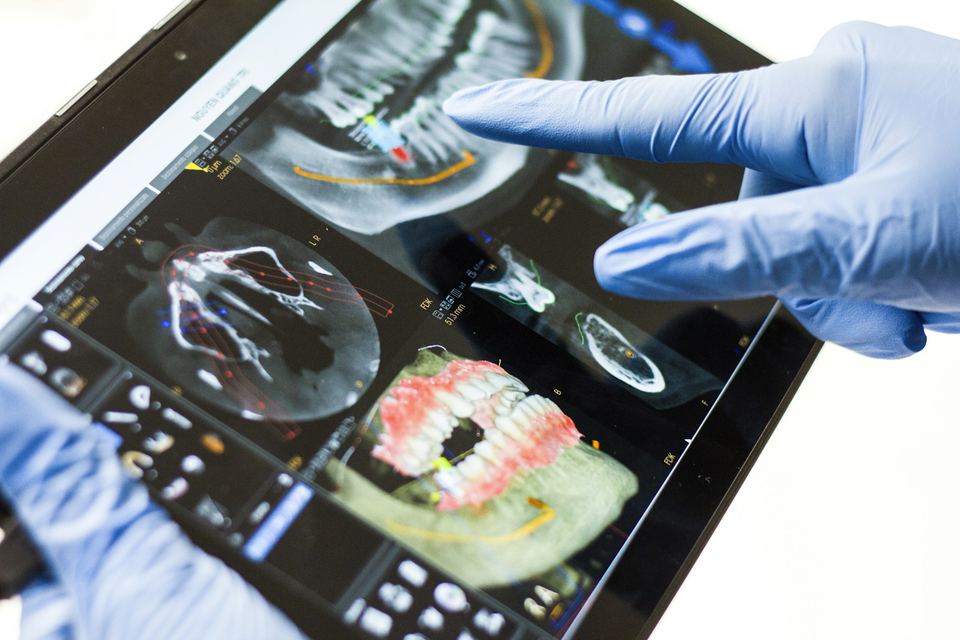
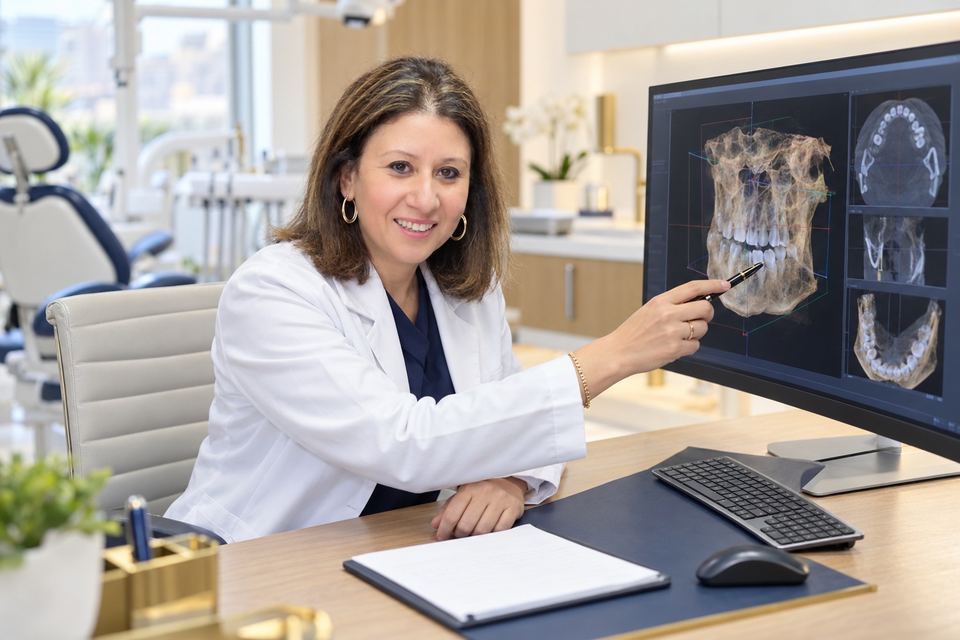
- CBCT scan and digital plan. A 3D scan measures the bone along the whole arch. We plan the teeth, then the number, position and angle of the implants, and identify any need for bone grafting.
- Trial and approval. You see the planned tooth shape and position, and we adjust it with you before any surgery.
- Surgery day. Under local anaesthetic, with sedation available on request where appropriate, any remaining failing teeth are removed and the implants are placed.
- Temporary fixed teeth. When the implants are firmly stable at placement, a temporary fixed bridge is usually fitted within a few days. If stability is not sufficient, we use a temporary removable denture instead and load the implants later; this is the safer choice in that situation.
- Healing and final bridge. After roughly 3 to 6 months of healing, we make the final bridge, usually zirconia or a hybrid of acrylic teeth on a titanium frame, and refine the bite, speech and appearance.
Fixed teeth soon after surgery are a real advantage, but not every case qualifies. Our page on immediate implants and same-day teeth explains the conditions.
Who full-arch implants are not right for
- Uncontrolled diabetes or other unstable health conditions, until they are controlled.
- Heavy smokers, who face a clearly higher risk of implant failure and bone loss over time.
- People taking certain bone medicines, especially intravenous bisphosphonates, or who have had radiotherapy to the jaws.
- Patients who cannot clean under a fixed bridge, for example because of reduced hand dexterity. A removable overdenture is often a better fit.
- Very severe bone loss where standard implants cannot be placed even with grafting. More specialised techniques exist, and we will refer you if that is the most suitable route.
- Expectations that do not match reality: a full-arch bridge looks and works much like natural teeth, but it is a prosthesis that needs maintenance.
Risks and how we manage them
Full-arch implant treatment is well established, but it is major treatment and its risks deserve plain explanation.
- Implant failure. With only 4 implants, losing one matters more than with 6. Careful planning, controlled loading of the temporary bridge and a soft diet during healing reduce this risk.
- Bridge fractures and wear. Acrylic teeth can wear or chip, and screws can loosen, especially in people who clench. We check the bite at every review and often recommend a night guard.
- Peri-implantitis. Plaque trapped under the bridge can inflame the gum and bone around the implants. The bridge is designed to be cleanable, and professional maintenance is part of the plan.
- Speech and adaptation. Some people notice a lisp or whistling for the first weeks while the tongue adapts.
- Post-operative swelling and bruising for several days, as expected after any larger surgery.
Alternatives to full-mouth implants
- Implant-retained overdenture. Two to four implants hold a removable denture firmly in place. Less surgery and lower cost, with a large gain in stability over a conventional denture.
- Conventional complete denture. No surgery and the lowest cost. Upper dentures are often comfortable; lower dentures are frequently loose.
- Saving some teeth. Gum treatment and selective extractions can sometimes keep strategic teeth for years, combined with a partial denture or a few implants.
- Several separate implant bridges. More implants, more cost and usually more bone needed, but repairs can be more localised.
Our article dentures or implants after 50 compares these choices for people facing them for the first time.
What affects the cost of full-mouth implants
Public listings in Cairo as of October 2026 put full-jaw implant treatment anywhere from about 40,000 to more than 200,000 EGP per jaw. The range is wide because the treatment itself varies so much. The main factors are:
- The number of implants (4, 5 or 6 or more) and the implant system.
- The final bridge material: acrylic on a titanium frame, or zirconia.
- Whether bone grafting or a sinus lift is needed.
- Extractions, temporary fixed teeth and sedation.
- One jaw or both.
The exact cost depends on an examination and a scan. When comparing offers, check whether the price includes the temporary bridge, the final bridge and the follow-up visits.
Recovery and long-term care
Expect swelling and bruising for about a week; most people plan several days off work. During healing you will follow a soft diet, avoiding biting into hard foods with the temporary teeth, because the implants are still integrating. We will review you regularly during this period.
With the final bridge, clean every day with a soft brush, a water flosser and floss threaders under the bridge. Professional maintenance visits, usually every 6 months, check the implants and bite; from time to time the bridge is removed for thorough cleaning. Look after it well and it can serve you for many years. Message us on WhatsApp if you would like to talk through whether you are a candidate.