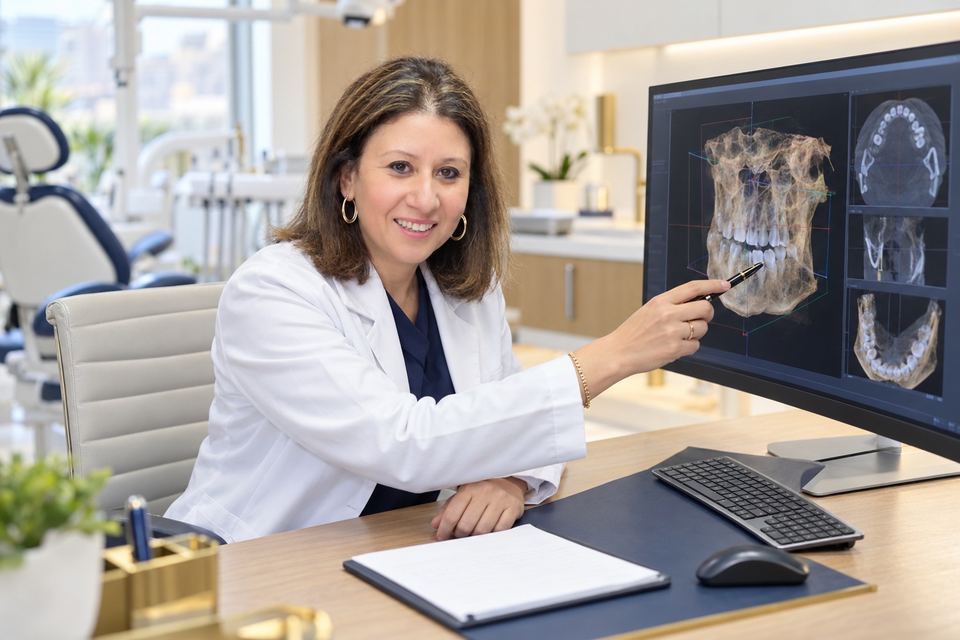
Three kinds of denture, three different experiences
"Denture" covers several quite different treatments, and choosing between them is the most important decision you will make.
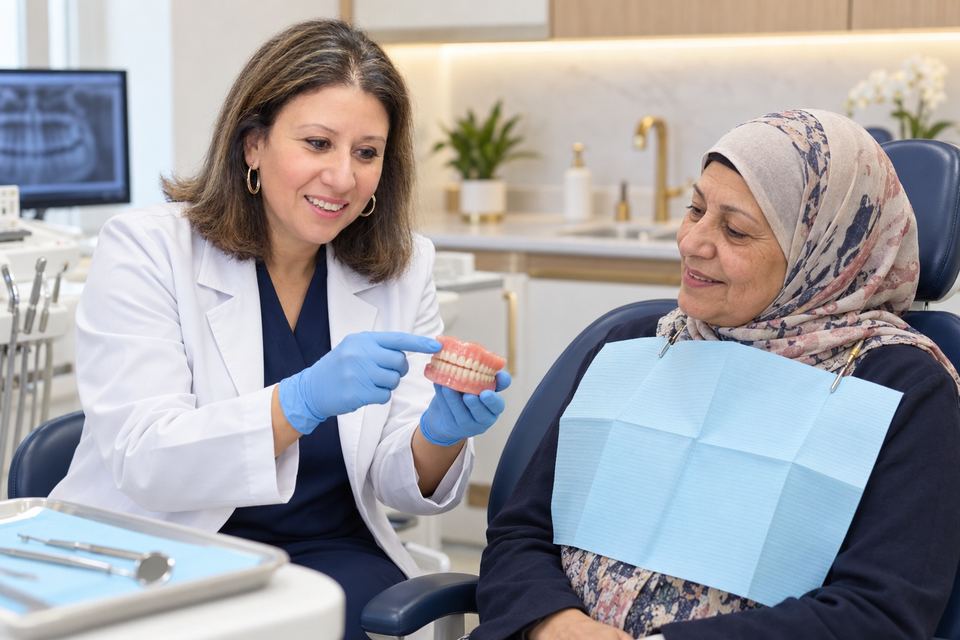
- Complete dentures replace all the teeth in a jaw and rest on the gums and the bone underneath.
- Partial dentures replace some missing teeth and are held by your remaining natural teeth.
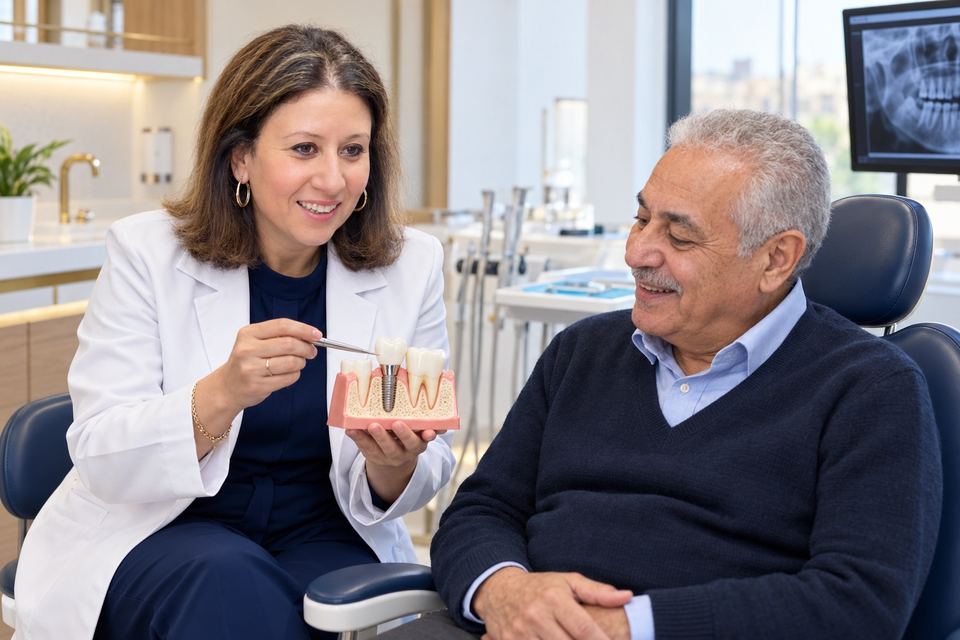
- Implant-retained overdentures are complete dentures that clip onto a small number of dental implants, usually two in the lower jaw, so they stay firmly in place.
All three are removable: you take them out to clean them. What differs is how securely they stay in while you talk, laugh and eat.
Complete dentures: made carefully, stage by stage
An upper denture usually holds well, because it covers the palate and forms a seal. A lower denture is a different story. The lower ridge is narrow, it keeps shrinking after the teeth are lost, and the tongue and cheeks move against the denture constantly. That is why so many people tell us their lower denture "floats", rubs, or traps food underneath.
A good complete denture cannot change that anatomy, but it can make the most of it. We take a preliminary impression, then a custom tray impression that captures the edges of the gums and muscles accurately. We record your bite and the height of your face, set the teeth in wax so you can see and test them, and only then make the final denture. Extra care at each stage is what separates a denture you tolerate from one you forget you are wearing.
Partial dentures: acrylic, flexible or chrome
When you still have some healthy teeth, a partial denture fills the gaps and helps stop the remaining teeth drifting. Acrylic partials are economical and easy to add to, but bulkier. Flexible partials use tooth- or gum-coloured clasps that are less visible but harder to adjust or repair. Cobalt-chrome partials have a thin metal framework that rests on the teeth, so they are slimmer, stronger and usually more comfortable for long-term use. We compare them in flexible vs acrylic vs chrome dentures.
Implant-retained overdentures: why two implants change daily life
This is the treatment Prof. Nouran Abdel Nabi knows most closely. She has published research on implant-retained overdentures in journals including The International Journal of Prosthodontics and the European Journal of Dentistry, and you can read more about her work on her profile.
The idea is simple. Two implants are placed in the front of the lower jaw, where the bone is usually thickest and well away from the main nerve. Small attachments are fitted to the implants, and matching parts inside the denture clip onto them. The denture still rests on the gums, but now it is anchored.
Stability: the denture stays where it belongs
With a conventional lower denture, the tongue lifts it when you speak and the cheeks push it when you laugh. Anchored to two implants, it stays put. Patients often describe the change as no longer having to "hold" the denture with their tongue and lips. Many find they no longer need denture adhesive at all.
Chewing: food you had given up on
Research comparing conventional lower dentures with two-implant overdentures has generally found better chewing ability and higher patient satisfaction with the overdenture. In everyday terms, that often means being able to bite into an apple, chew meat or raw vegetables, and eat a full meal without sore spots. It will not feel exactly like natural teeth, but it is usually a clear step forward.
Confidence: talking and eating without worry
For many people the biggest change is not mechanical. It is being able to eat at a family gathering, speak in a meeting or laugh out loud without wondering whether the denture will move. That quiet confidence is why international expert consensus statements, beginning with the McGill Consensus in 2002, recommended the two-implant overdenture as the first-choice standard of care for people with no teeth in the lower jaw.
What it does not do: an honest summary
- It is still removable. You take it out daily to clean it and the implants, and usually at night.
- It still rests partly on the gums, so it does not stop all bone shrinkage under the back of the denture; occasional relining may be needed.
- The nylon inserts in the attachments wear with use and need replacing from time to time, often every year or two, as part of normal maintenance.
- It needs a minor surgical procedure and a healing period.
- For the upper jaw, overdentures usually need more implants, often four, because the bone is softer.
For a deeper look at the evidence in plain language, read implant overdentures: the research explained. In many cases a well-fitting existing denture can be adapted to clip onto new implants, which can reduce cost.
How we make your denture or overdenture, step by step
- Consultation. We examine your gums, bone and any remaining teeth, listen to what troubles you about your current denture, and discuss the options that fit your health and budget.
- Impressions and bite records. Accurate impressions and careful bite measurements are taken over one or more visits.
- Wax try-in. You see the teeth set in wax, check the look and the bite, and we adjust before anything is finalised.
- Implant placement, for overdentures. Two implants are placed under local anaesthetic, usually in a short procedure. You keep wearing an adjusted denture while they heal.
- Fitting and attachments. The denture is fitted and, for overdentures, connected to the implant attachments once healing allows, typically after about 2 to 4 months.
- Adjustments and reviews. Small sore spots are normal at first; short adjustment visits in the following weeks make a big difference.
Who each option suits, and who it does not
Conventional dentures suit people who want to avoid surgery, have medical reasons not to have implants, or need an affordable solution. They are less suitable for people with very little bone left in the lower jaw, where stability will be limited.
Implant-retained overdentures suit people with a loose lower denture, those who want much more stability without the cost of fixed teeth, and older patients who find a removable design easier to clean than a fixed bridge. They are not suitable, or need extra caution, for people with uncontrolled diabetes, heavy smokers, those on certain bone medicines such as intravenous bisphosphonates, or after radiotherapy to the jaws.
If you would prefer teeth that never come out, see full-mouth implants; we will compare the two honestly.
Risks and how we manage them
- Sore spots and ulcers in the first weeks. These are adjusted promptly; a sore that does not heal within two weeks should always be checked.
- Denture stomatitis, a fungal inflammation under the denture, linked to wearing it overnight and imperfect cleaning. Good hygiene and leaving the denture out at night prevent most cases.
- Gradual loosening as the bone changes. A reline refits the denture to the gums.
- For overdentures: a small risk of an implant failing to integrate, inflammation around the implants if they are not cleaned, and wear of attachment parts. Regular reviews catch these early.
What affects the cost
As a guide, public listings in Cairo as of October 2026 showed acrylic dentures at about 8,000 to 15,000 EGP and cobalt-chrome partial dentures at about 10,000 to 20,000 EGP. An implant-retained overdenture adds the cost of the implants and attachments, but it usually remains well below a fixed full-arch bridge. Cost depends on the type of denture, the materials and teeth used, the number of implants, whether your current denture can be converted, and any extractions or relines needed. The exact cost for you depends on an examination.
Living with your new denture
New dentures take some getting used to. Start with soft food cut into small pieces, chew on both sides at once, and read aloud to help your speech settle. Most people adapt within a few weeks.
Clean your denture every day with a soft brush and non-abrasive cleaner, rinse after meals, and leave it out overnight in water or a cleaning solution. With an overdenture, also brush around the implant attachments gently each day. Come in at least once a year so we can check the fit, the gums and, where relevant, the implants and inserts. If your current denture is loose or uncomfortable, message us on WhatsApp and we will tell you which option is worth discussing.