What a dental implant is, and what it replaces
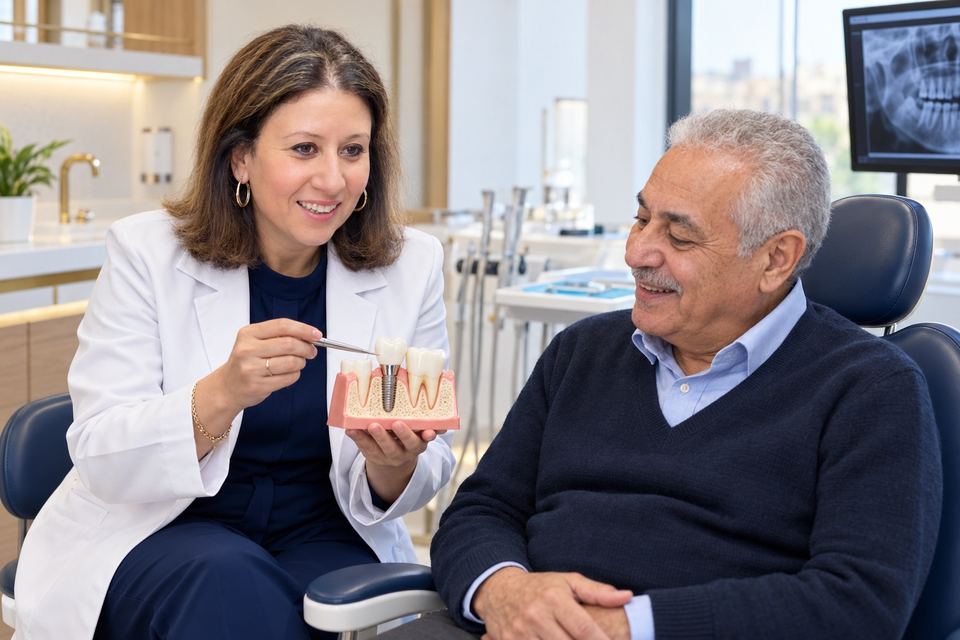
A dental implant is a small post, usually made of titanium, that is placed in the jawbone where a tooth root used to be. Over the following weeks the bone grows tightly against its surface, a process called osseointegration. Once it is anchored, the implant supports a crown, a bridge or a denture: the visible part you actually chew with.
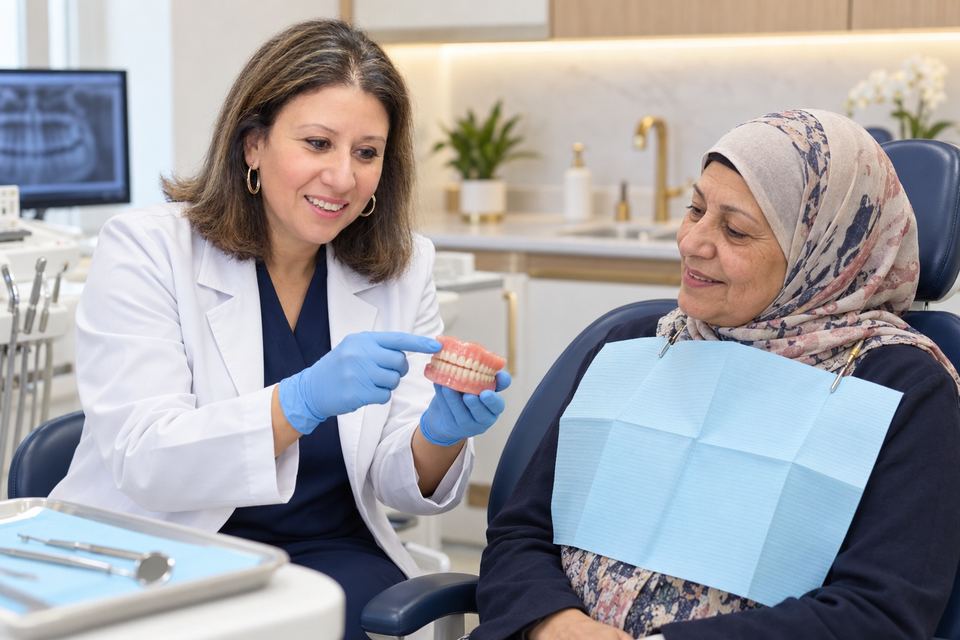
Implants can replace a single missing tooth, several teeth in a row, or a whole arch. Unlike a conventional bridge, an implant does not need the neighbouring teeth to be filed down. Unlike a removable partial denture, it does not rest on the gums or clip onto other teeth.
This page covers single and multiple implants. If you are missing most or all of your teeth in one jaw, see our page on full-mouth implants, which uses a different design and planning approach.
How Prof. Nouran plans an implant: the final tooth comes first
Prof. Nouran Abdel Nabi works in prosthodontics, the dental specialty concerned with replacing teeth and restoring how the mouth works. That shapes the order in which we think. We do not start by asking where there is bone for a screw. We start by asking where the new tooth should sit, how it should look next to your other teeth, and how it will meet the opposite jaw when you bite.
Only once the final tooth is planned do we decide where the implant should go, at what angle and depth, and what size it should be. An implant placed purely where bone happens to be convenient can end up under a crown that is hard to clean, looks too long, or takes biting forces at an awkward angle. Planning backwards from the tooth is how we avoid that.
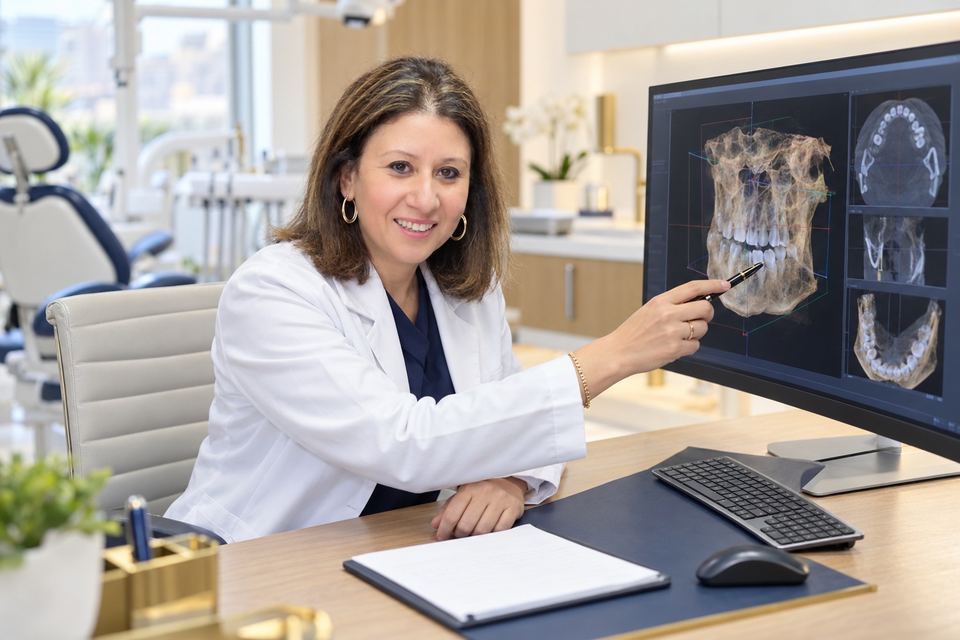
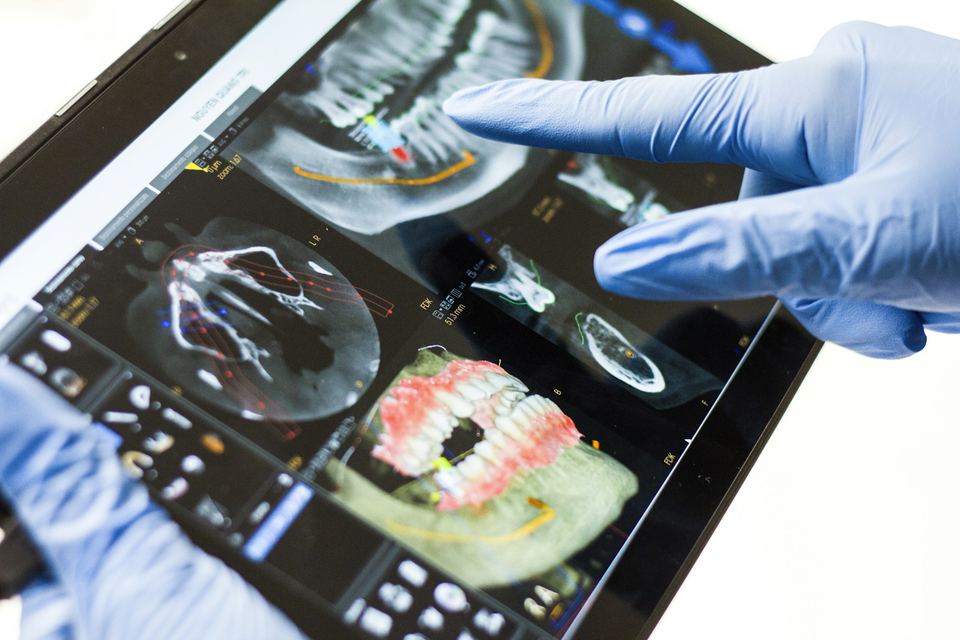
In practice this means a careful look at your bite, gum line and smile, photographs and models where useful, and a 3D CBCT scan to measure bone height and width and to locate the nerve in the lower jaw and the sinus in the upper jaw. For more demanding cases, a surgical guide (a custom template made from the plan) can be used to transfer the planned position into the mouth.
Dental implant treatment, step by step
- Consultation and examination. We listen to what bothers you, check your gums, remaining teeth and bite, and review your general health and any medicines you take.
- CBCT scan and planning. A low-dose 3D scan shows the bone in detail. We plan the final tooth, then the implant position, and explain your options and the expected timeline clearly before you decide.
- Preparing the site, if needed. Infected teeth are treated or removed and gum disease is brought under control first. If the bone is thin, a bone graft or sinus lift may be needed, sometimes at the same visit as the implant.
- Placing the implant. Under local anaesthetic, the implant is placed through a small opening in the gum. A single straightforward implant usually takes less than an hour, and most patients describe pressure and vibration rather than sharp pain.
- Healing. The bone typically needs about 2 to 4 months in the lower jaw and 3 to 6 months in the upper jaw, longer after grafting. When a front tooth is involved, we plan a temporary tooth so you are not left with a visible gap.
- Fitting the crown. We take an impression, choose the shade and shape with you, and fit a screw-retained or cemented crown, usually zirconia or porcelain. The bite is checked carefully so the implant is not overloaded.
In suitable cases, with healthy bone, no active infection and a very stable implant at placement, an implant can go in on the day of extraction or carry a temporary tooth straight away. We explain when that is sensible, and when it is not, in our guide to immediate implants and same-day teeth.
Who dental implants suit
- Adults whose jaw growth is complete and who have lost one or more teeth to decay, a crack, gum disease or injury.
- People who want to replace a missing tooth without cutting down healthy neighbouring teeth for a bridge.
- Patients with a loose or uncomfortable partial denture who would prefer something fixed.
- People with enough bone, or in whom bone can be rebuilt predictably with grafting.
- Anyone prepared to clean carefully around the implant and to attend regular check-ups.
Not sure whether this describes you? Our answer to am I a candidate for dental implants? walks through the questions we ask at the first visit.
When implants are not the right choice, or not yet
Implants work very well in the right situation, but they are not right for everyone. If we think another option suits you better, or something needs to be fixed first, we will say so plainly.
- Uncontrolled diabetes or other unstable medical conditions slow healing and raise the risk of infection. Once the condition is controlled, implants are often possible.
- Heavy smoking is one of the strongest known risk factors for implant failure and for bone loss around implants years later.
- Active gum disease has to be treated first, because the same bacteria can attack the bone around an implant.
- Some medicines and treatments, especially bisphosphonates and similar drugs for osteoporosis or cancer, and radiotherapy to the head and neck, need careful discussion with your physician and can rule implants out.
- Teenagers whose jaws are still growing usually need to wait, with a temporary solution in the meantime.
- Pregnancy: elective implant surgery is normally postponed until after the baby is born.
Risks of dental implants and how we manage them
Implant treatment has a high success rate, and long-term studies commonly report that well over 90% of implants are still functioning after 10 years. That still leaves a small minority that do not integrate or develop problems later, and you deserve to know what those are.
- Early failure to integrate. Occasionally the bone does not bond to the implant. It is removed, the site is allowed to heal, and in most cases a new implant can be placed later.
- Peri-implantitis. This is inflammation and bone loss around an implant, usually linked to plaque, smoking or a crown that is hard to clean. Good crown design, daily cleaning and regular reviews are the main protection.
- Nerve or sinus involvement. The CBCT scan lets us measure safe distances from the nerve and the sinus before we start, rather than estimating from a flat X-ray.
- Mechanical problems. Screws can loosen and porcelain can chip, especially in people who grind their teeth. Careful bite adjustment and a night guard reduce this.
- Swelling, bruising and soreness for a few days after surgery, usually managed with ordinary painkillers and cold packs.
Alternatives to a dental implant
| Option | Advantages | Trade-offs |
|---|---|---|
| Dental implant | Fixed and independent; neighbouring teeth untouched; helps preserve the bone | Minor surgery, healing time, higher upfront cost |
| Tooth-supported bridge | Fixed, faster, no surgery | Neighbouring teeth are filed down; cleaning under it takes care |
| Removable partial denture | Lower cost, no surgery, teeth can be added later | Removable, less stable, can stress the teeth it clips onto |
| Leaving the gap | No cost now | Neighbouring teeth may tilt and the opposing tooth may drift into the space |
We compare these in more depth in implants vs bridge vs denture. Sometimes the honest answer is that a bridge or a well-made partial denture is the more sensible choice for you.
What affects the cost of dental implants in Cairo
As a rough guide, public listings for clinics in Maadi showed a single implant with its crown at around 10,000 to 30,000 EGP as of October 2026, with promotional offers advertised at 5,950 to 7,800 EGP. Those numbers vary so widely because they rarely include the same things. The main factors are:
- The implant system and its components, including the abutment that connects implant to crown.
- Whether a bone graft, sinus lift or membrane is needed.
- The CBCT scan and, where used, a surgical guide.
- The crown material (zirconia, E.max or porcelain-fused-to-metal) and whether it is screw-retained.
- Temporary teeth during healing, and the number of implants involved.
When comparing quotes, ask exactly what is included: the implant brand, the abutment, the crown, the scan and the follow-up visits. The exact cost for you depends on an examination. Our 2026 guide to dental implant costs in Cairo breaks this down further.
Recovery and aftercare
Most people return to desk work the day after a single implant. Expect some swelling and tenderness for 2 to 3 days. Eat soft food, chew on the other side, avoid hot drinks on the first day, and start gentle warm salt-water rinses after 24 hours. Take any medicines exactly as prescribed, and do not smoke: it slows healing and raises the risk of failure.
Once your crown is fitted, an implant cannot decay, but the gum and bone around it can still become inflamed. Brush twice a day, clean around the implant with interdental brushes or a water flosser, and keep your check-ups, usually every 6 months, with an X-ray from time to time to monitor the bone. If you grind your teeth, wear the night guard we make for you.
If you are not sure where to start, message us on WhatsApp, with a recent X-ray if you have one, and we will suggest the right first step.