What a dental crown is, and when you need one
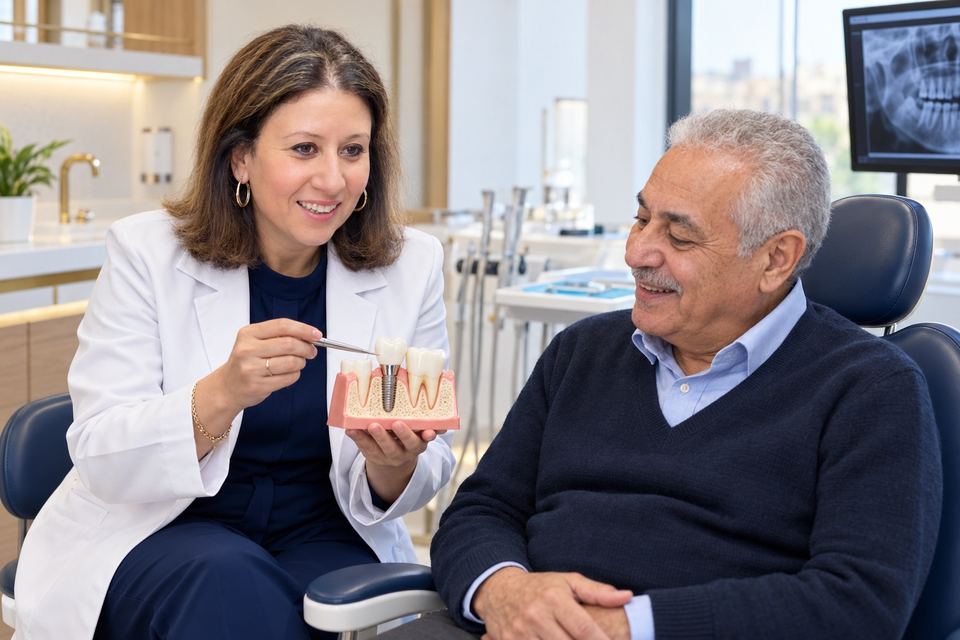
A crown, often called a cap and known in Egypt as a تلبيسة, is a custom-made cover that fits over the whole visible part of a tooth. It restores the tooth's shape and strength and protects what is left of it from cracking further.
We usually recommend a crown when:
- A tooth has a large filling and too little natural tooth left to hold another one safely.
- A tooth is cracked or a cusp has broken off.
- A back tooth has had root canal treatment and is now more brittle; our answer to do I need a crown after a root canal? explains when this applies.
- Teeth are severely worn from grinding or acid erosion.
- An implant needs a tooth on top of it.
A crown is not always the answer. If a smaller restoration such as a filling, an onlay (a partial crown that covers only the weakened part) or a veneer can do the job, we will usually prefer it, because it keeps more of your natural tooth.
What a dental bridge is
A bridge replaces one or more missing teeth by joining a false tooth to crowns on the teeth either side of the gap. Those supporting teeth are called abutments. The whole bridge is cemented in place and does not come out.
Bridges are fixed and comparatively quick, with no surgery. Their main drawback is that the abutment teeth must be shaped for crowns, which is a real cost if those teeth are healthy and unfilled. In that situation, an implant often makes more sense. If the neighbouring teeth already have large fillings or need crowns anyway, a bridge can be an excellent choice. For a single missing front tooth, a resin-bonded bridge, attached with a small wing to the back of a neighbouring tooth, can sometimes avoid shaping that tooth at all.
Choosing the material: zirconia, E.max or porcelain-fused-to-metal
| Material | Strengths | Limitations | Typical use |
|---|---|---|---|
| Zirconia | Very strong, metal-free, good for heavy biting forces | Solid zirconia is slightly more opaque; layered zirconia can chip | Back teeth, bridges, implant crowns, people who grind |
| E.max (lithium disilicate) | Highly natural translucency; can be bonded and made thin | Less strong than zirconia for long bridges or heavy grinders | Front teeth, premolars, single crowns |
| Porcelain-fused-to-metal | Long track record, strong, often lower cost | Metal can show as a grey line at the gum; more tooth reduction; porcelain can chip | Back teeth and bridges where cost matters |
There is no single right material for every tooth. A front tooth beside natural teeth, a molar in someone who clenches, and a crown on an implant each have different demands. We go into the details in zirconia vs E.max vs porcelain crowns.
How Prof. Nouran plans crowns and bridges
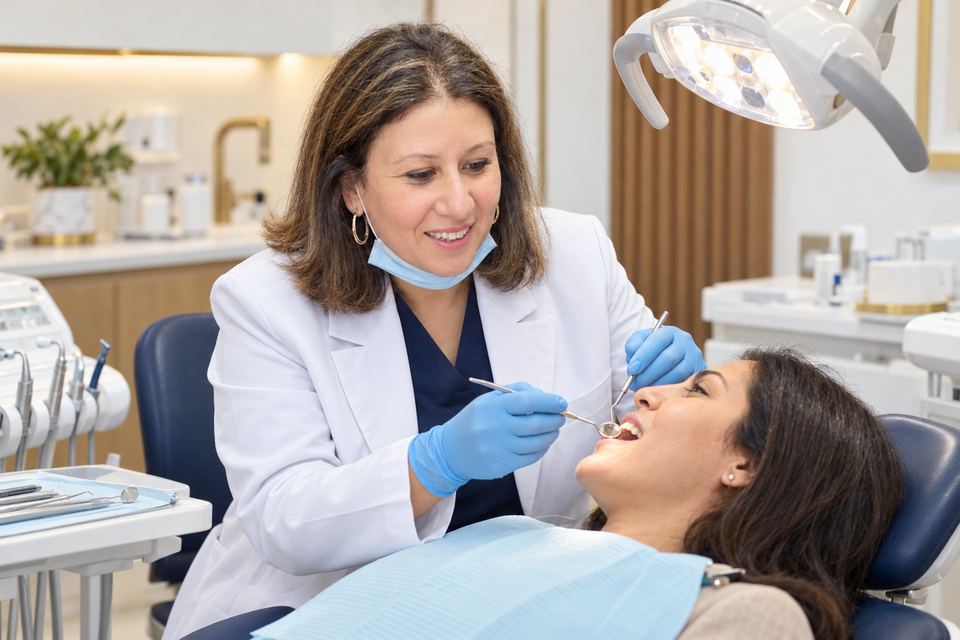
As a prosthodontist, Prof. Nouran Abdel Nabi treats a crown as part of your whole bite, not as a single tooth in isolation. Before preparing a tooth we check that it has a sound root and healthy gum, that your bite is stable, and whether grinding or clenching will place extra load on it.
We aim to remove only as much tooth as the chosen material needs, and we keep the edge of the crown where it can be cleaned. For front teeth, we photograph your smile, choose the shade in natural light, and can use a temporary crown to test the shape and length before the final one is made. A crown that looks good on day one but traps plaque at the gum, or hits too hard when you bite, will not last; careful planning avoids both.
Crowns and bridges step by step
- Examination and X-rays. We check the tooth, its root, the gum and your bite, and confirm that a crown or bridge is the right restoration.
- Treatment of underlying problems. Decay is removed, and if the nerve is infected, root canal treatment is done first. A core build-up rebuilds the tooth if needed.
- Preparation and impression. Under local anaesthetic, the tooth is shaped, and a digital or conventional impression is taken. You leave with a temporary crown or bridge.
- Shade and design. The dental laboratory makes your crown to the agreed shade and shape.
- Try-in and fitting. We check fit, colour, contacts and bite, adjust as needed, then cement or bond the final crown or bridge.
For crowns on implants, there is no tooth preparation: we take an impression of the implant and fit either a screw-retained crown, which can be removed for maintenance, or a cemented one, depending on the implant position and the space available.
Who crowns and bridges are not right for
- Teeth with a poor long-term outlook, such as very loose teeth or roots with large infections, may not be worth crowning. We will tell you if extraction and another option are more sensible.
- Healthy, unfilled teeth should not be cut down for a bridge without discussing an implant first.
- People with heavy grinding need the right material and a night guard; otherwise fractures are more likely.
- Active gum disease should be treated before crowns are made, so the gum line is stable.
- Purely cosmetic changes to healthy front teeth can often be achieved with veneers, which remove less tooth; see veneers and smile design.
Risks and how we manage them
- Sensitivity after preparation is common for a few days or weeks and usually settles.
- Nerve inflammation. A deeply decayed or heavily restored tooth may need root canal treatment later, even after a well-made crown. We assess this risk beforehand and keep preparation as conservative as possible.
- Chipping or fracture, especially with layered porcelain or in people who grind. Material choice, bite adjustment and a night guard reduce this.
- Decay at the edge of the crown or under a bridge if cleaning is neglected. Crowns can still decay where they meet the tooth.
- Gum recession over the years can expose the edge of an older crown, particularly metal-based ones.
- Loss of a bridge if an abutment tooth develops decay or gum problems, which is why regular check-ups matter.
Alternatives to crowns and bridges
Depending on the tooth: a filling, an onlay, a veneer for front teeth, an implant to replace a missing tooth, or a removable partial denture. Our comparison of implants, bridges and dentures may help if you are deciding how to fill a gap.
What affects the cost of crowns and bridges in Cairo
As a rough guide, public listings in Cairo as of October 2026 showed zirconia crowns at roughly USD 95 to 250 each (paid in Egyptian pounds at the current rate). Bridges are usually priced per unit, so a three-unit bridge costs about three times a single crown. Cost depends on the material, whether the crown is solid or layered, the laboratory, any root canal or core build-up needed, and whether it is on a natural tooth or an implant. The exact cost for you depends on an examination.
Aftercare: making your crown or bridge last
Brush twice daily and clean between the teeth every day. Under a bridge, use a floss threader, superfloss or a water flosser to clean beneath the false tooth. Avoid using your teeth to crack nuts, open packages or chew ice, and wear a night guard if you grind.
Come for check-ups, usually every 6 months, so we can spot early decay at the margins or changes in the gum. A well-made crown that is cared for typically serves for many years. If a tooth is broken, heavily filled or recently root-treated, message us on WhatsApp and we will advise on the right restoration.