Short answer
An implant replaces a tooth without touching neighbouring teeth and helps preserve bone, but needs surgery and costs more. A bridge is fixed and quicker but requires shaping adjacent teeth. A denture is the least invasive and least expensive but is removable and less stable. The right choice depends on your bone, health, budget and remaining teeth.

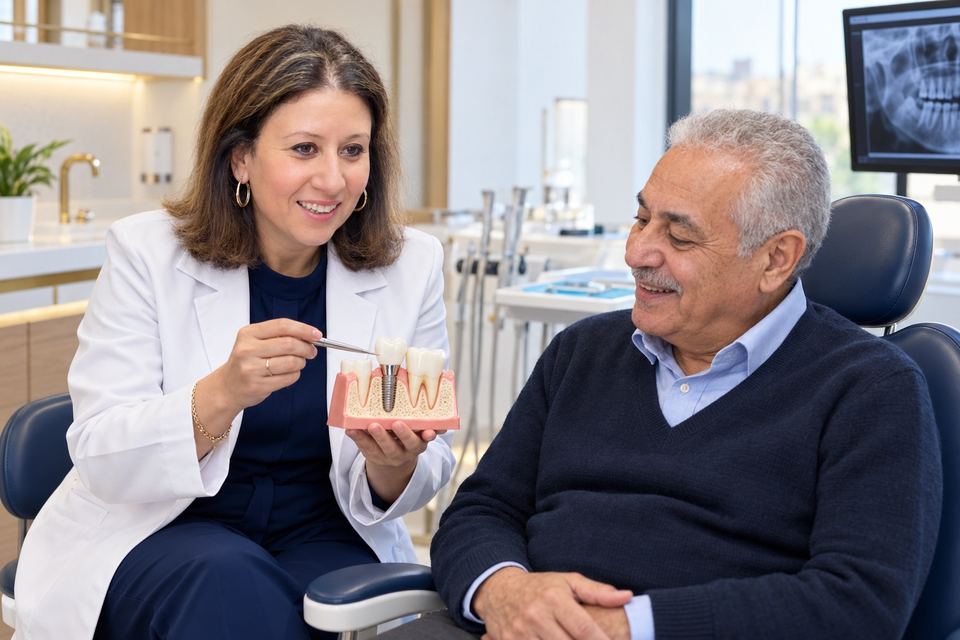
There is no single right answer for everyone. A dental implant replaces the root and the tooth, leaves neighbouring teeth untouched and helps preserve the jawbone, but it involves surgery, takes months and costs more at the start. A bridge is fixed in place and can be completed in a couple of weeks, but it relies on shaping the teeth on either side. A denture is the least invasive and usually the least expensive, but it is removable and can move when you eat or speak. The right option depends on your bone, gums, health, remaining teeth, budget and priorities.
As prosthodontists, we spend much of our time helping patients weigh these trade-offs. Here is a clear side-by-side comparison, followed by typical situations where each option makes the most sense.
Implant, bridge and denture at a glance
| Dental implant | Fixed bridge | Removable denture | |
|---|---|---|---|
| Fixed or removable | Fixed (or holds a removable overdenture) | Fixed | Removable |
| Effect on neighbouring teeth | None | Adjacent teeth are shaped for crowns | Partial dentures may clasp onto teeth |
| Effect on jawbone | Helps maintain bone | Bone under the gap continues to shrink | Bone continues to shrink; may speed it up |
| Surgery needed | Yes, minor oral surgery | No | No |
| Typical treatment time | About 3–6 months (sometimes longer) | About 1–3 weeks | About 2–6 weeks |
| Chewing and stability | Close to natural teeth | Very good | Reduced; varies with fit |
| Typical lifespan | Implant often 20+ years; crown 10–15 | Often 10–15 years | Reline every few years; remake after 5–10 |
| Upfront cost | Highest | Moderate | Lowest |
For context, Cairo public listings in October 2026 show single implants at roughly 10,000–30,000 EGP and dentures around 5,000–15,000 EGP for acrylic or 10,000–20,000 EGP for chrome. Exact costs always depend on an examination. See how much dental implants cost in Cairo for the factors involved.
When a dental implant is usually the stronger option
- You are missing one tooth and the teeth on either side are healthy and unrestored.
- You want a fixed tooth that you clean like a natural one.
- You have enough bone, or can have it rebuilt, and your health allows minor surgery.
- You want to slow bone loss in the area of the missing tooth.
The main trade-offs are surgery, healing time and cost. Implants also need good hygiene and regular checkups to stay healthy. Our guide on whether you are a candidate for dental implants covers the medical considerations.
When a bridge makes sense
- The teeth on either side of the gap already have large fillings or crowns, so shaping them is less of a sacrifice.
- Surgery is not advisable for medical reasons, or you prefer to avoid it.
- You need a fixed result relatively quickly.
- Bone is insufficient and you do not wish to have grafting.
The trade-off is that the supporting teeth carry extra load and can develop decay at the edges of the crowns. Cleaning under a bridge needs special floss or brushes. Modern bridges are commonly made from zirconia or porcelain-based materials; see our crowns and bridges page.
When a denture is the right choice
- Many or all teeth are missing and a lower-cost, non-surgical option is preferred.
- Your health makes surgery unsuitable.
- You need a temporary solution while implants heal or while deciding on longer-term treatment.
- Gum and bone loss is significant and the denture also needs to support the lips and face.
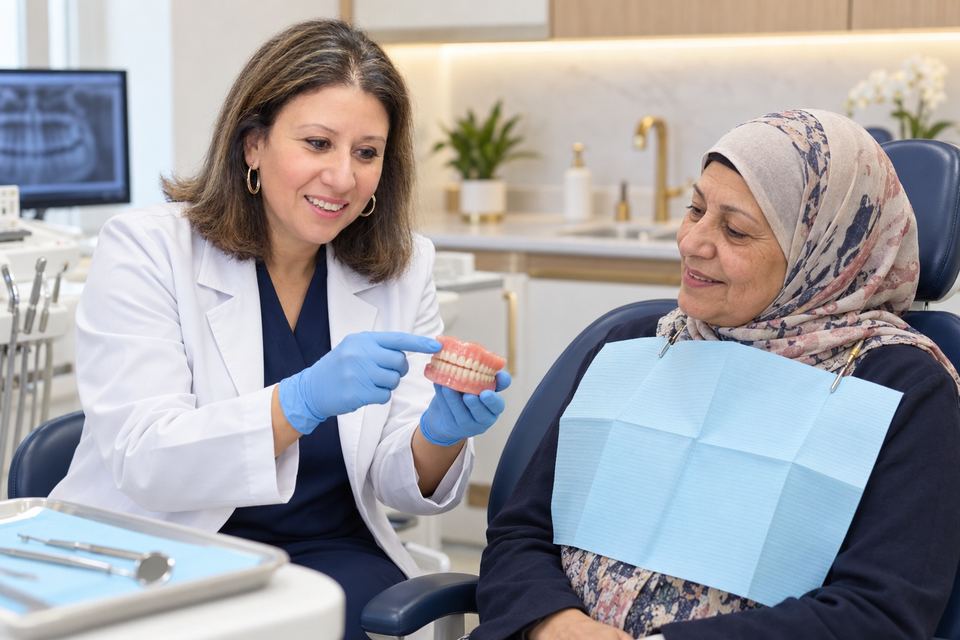
Modern dentures can look very natural. The trade-offs are reduced chewing efficiency, the need to remove and clean them daily, gradual loosening as the bone changes, and the adjustment period. Our dentures page explains the types available.
The middle ground: implant-retained overdentures
For people missing all their teeth, especially in the lower jaw, there is an important option between a conventional denture and a full fixed implant bridge. Two or more implants are placed, and the denture clips onto them. This dramatically improves stability compared with a conventional lower denture, at a lower cost and with less surgery than a fixed full arch. This is the area of Prof. Nouran Abdel Nabi's published research. Read the full explanation in what is an implant-retained overdenture?
Common scenarios and how we usually advise
One missing front tooth, healthy neighbours
An implant is often preferred to avoid cutting down healthy teeth, provided bone and gum conditions are favourable. A resin-bonded bridge, which needs minimal preparation, can be an alternative for some patients.
One missing back tooth, neighbours heavily filled
A bridge and an implant are both reasonable. Many patients still choose an implant to avoid linking teeth together, but a bridge can make sense if the adjacent teeth need crowns anyway.
Several missing teeth in different areas
A partial denture is the most economical; implants or bridges can replace key teeth first, and a plan can be phased over time.
All teeth missing in one jaw
Options range from a conventional complete denture, to an implant-retained overdenture, to a fixed full-arch bridge on four to six implants. Our All-on-4 vs All-on-6 guide covers the fixed options.
What doing nothing means
Leaving a gap is also a choice, and sometimes a reasonable one for a back tooth that does not affect chewing. Over time, however, neighbouring teeth can tilt, the opposing tooth can over-erupt, and bone shrinks, which may make later treatment more complex.
How we help you decide at El Nabi
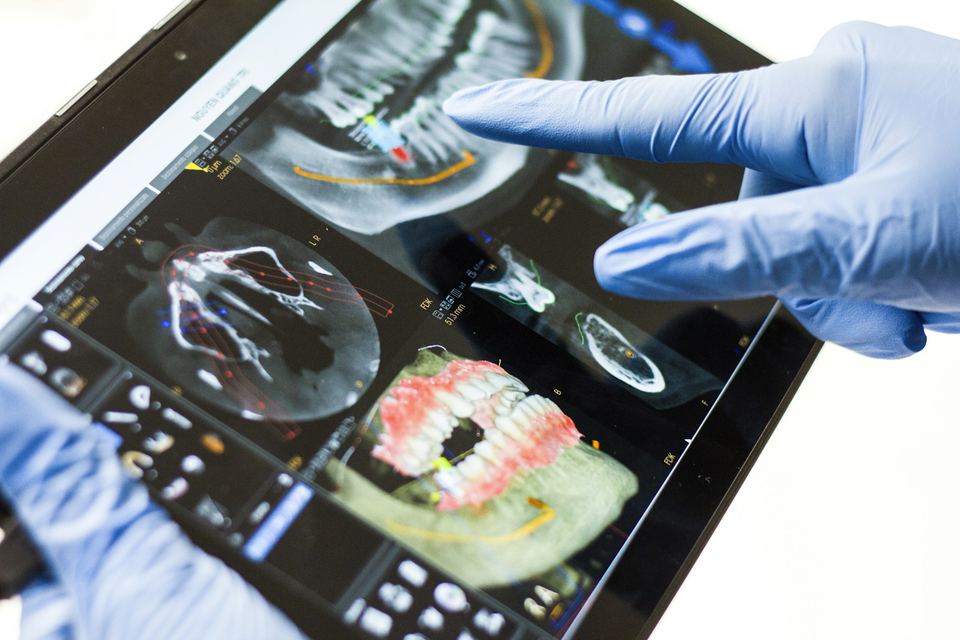
At our clinic in Maadi, Prof. Nouran Abdel Nabi examines your teeth, gums and bite, takes the X-rays needed and, where implants are being considered, a 3D scan. We then present the realistic options for your mouth, with their benefits, risks, time and maintenance, and let you decide with full information. We are comfortable recommending a bridge or a denture when that is the more appropriate choice.
When to see a dentist
If you have a gap, a failing tooth or a denture that no longer fits, an assessment will show which options are realistic for you. You can message us on WhatsApp or book through our contact page.
Recognise yourself in this?
Send us a message or a photo of your X-ray on WhatsApp. Prof. Nouran will look at your case and give you a clear plan, with no pressure to start.