Short answer
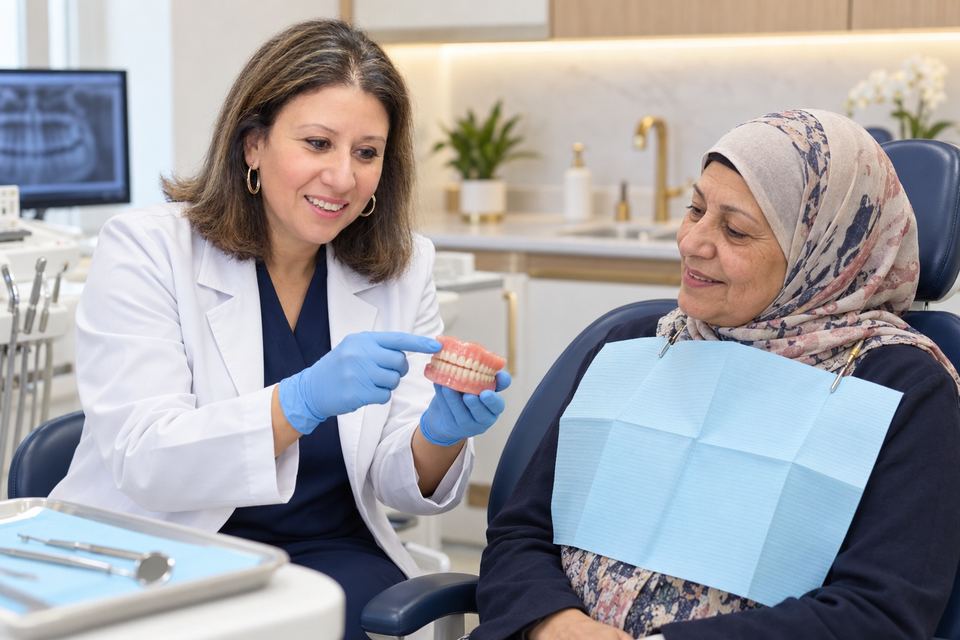
Most people adjust to new dentures within about 2–4 weeks, though full comfort with a lower denture can take a few months. Expect extra saliva, some sore spots, a change in speech and a learning period for chewing in the first days. Sore spots should be adjusted by your dentist rather than endured.

Most people feel reasonably comfortable with new dentures within about two to four weeks. Speaking usually settles within days, eating takes a little longer, and full confidence with a lower denture can take a few months, because it relies more on your tongue and cheek muscles learning to hold it. In the first days it is normal to notice extra saliva, a feeling of fullness, some changes in speech and a few sore spots. Sore spots are not something to endure: a short adjustment visit usually fixes them.
Knowing what to expect makes the adjustment period much easier. Here is a practical guide, from the first day to the first few months.
A typical adjustment timeline
| Period | What is common | What helps |
|---|---|---|
| Days 1–3 | Bulky feeling, extra saliva, lisping, mild gagging for some | Wear them as advised, read aloud, soft foods cut small |
| Week 1 | Sore spots appear where the denture presses | Adjustment visit; do not file or bend the denture yourself |
| Weeks 2–4 | Speech mostly normal, chewing improving | Gradually reintroduce firmer foods, chew on both sides |
| Months 1–3 | Lower denture control improves as muscles adapt | Patience; review visit to check fit and bite |
Why new dentures feel strange at first
Your mouth is very sensitive to small changes. A new denture changes the space for your tongue, the support of your lips and the way your teeth meet. Your brain needs time to relearn movements for speaking and chewing. People who had immediate dentures fitted after extractions also experience gum shrinkage as healing continues, which changes the fit over the first months.
Eating with new dentures
- Start with soft foods such as eggs, yoghurt, cooked vegetables, rice, fish and soft bread.
- Cut food into small pieces and chew slowly with food on both sides at the same time. This keeps the dentures balanced.
- Avoid biting into whole apples or sandwiches with the front teeth at first; it tends to tip the dentures.
- Be careful with very hot food and drinks, because the denture reduces your ability to feel temperature.
- Avoid very sticky or hard foods until you are confident.
Speaking with new dentures
Some sounds, especially "s" and "f", may be difficult at first. Reading aloud and repeating tricky words in front of a mirror helps your tongue adapt quickly. If your dentures click when you talk, speak a little more slowly. If they move upward when you laugh or cough, gently bite down and swallow to reseat them. Persistent clicking or whistling after a couple of weeks should be checked.
Extra saliva, gagging and taste
Increased saliva is the mouth's normal response to a new object and usually settles within a week or two. A mild gag reflex often fades as you adapt; if it continues, the back edge of an upper denture can sometimes be adjusted. Taste may seem slightly reduced with an upper denture covering the palate, though most people adapt. For those who find palate coverage a lasting problem, implant-supported options can sometimes reduce it.
Sore spots: what is normal and what is not
Small sore spots in the first week are common, because no denture fits perfectly on day one when the gum is under chewing load. What matters is that they are adjusted. Your dentist can identify pressure areas and relieve them precisely.
- Do come for adjustment visits, ideally wearing the denture for a few hours beforehand so the sore area is visible.
- Do rinse with warm salt water if advised.
- Do not try to file, cut or bend the denture yourself.
- Do not ignore an ulcer that has not healed within two weeks; it needs to be examined.
Should I sleep in my dentures?
In the first day or two your dentist may ask you to keep them in, especially after extractions, to help identify pressure points. After that, most dentists advise removing dentures at night to give the gums a rest and reduce the risk of fungal infection. Store them in water or a cleaning solution so they do not dry out.
Can I use denture adhesive?
A small amount of adhesive can add confidence while you are adjusting, particularly with a lower denture. However, adhesive should not be needed to compensate for a denture that clearly does not fit. If you find yourself using more and more, the denture may need adjusting or relining. See what to do about a loose denture.
Daily care for new dentures
- Remove and rinse after meals when possible.
- Brush the dentures daily with a soft brush and a non-abrasive cleaner, not regular toothpaste, which can scratch acrylic.
- Clean your gums, tongue and any remaining teeth.
- Handle dentures over a folded towel or a basin of water, so they do not break if dropped.
When adjustment is harder than expected
Some people, especially those with a lot of bone loss in the lower jaw, a dry mouth or reduced muscle control, find conventional dentures difficult even after careful adjustment. That does not mean they have failed. For many of these patients, two implants holding the lower denture make a dramatic difference. Read more in what is an implant-retained overdenture?
How we support denture wearers at El Nabi
At our clinic in Maadi, dentures are planned by Prof. Nouran Abdel Nabi, whose background in prosthodontics includes research on denture and overdenture designs. We take careful impressions and bite records, check the appearance with you before the final denture is made, and schedule follow-up visits in the first weeks to make adjustments. Our dentures page describes the types we make and the steps involved.
When to see a dentist
Book a review if a sore spot does not improve within a few days of adjustment, a sore persists beyond two weeks, the denture rocks or drops while you speak, or you cannot eat comfortably after a month. You can message us on WhatsApp to arrange a visit.
Recognise yourself in this?
Send us a message or a photo of your X-ray on WhatsApp. Prof. Nouran will look at your case and give you a clear plan, with no pressure to start.