Short answer
A front tooth implant can look very natural, but it is the most demanding place for an implant because the gum line and thin bone show when you smile. Treatment usually takes about 3–6 months, longer if bone or gum needs rebuilding. You are not normally left with a gap: a removable temporary, a bonded (Maryland) temporary bridge or, in suitable cases, a fixed temporary crown on the implant is worn while it heals.

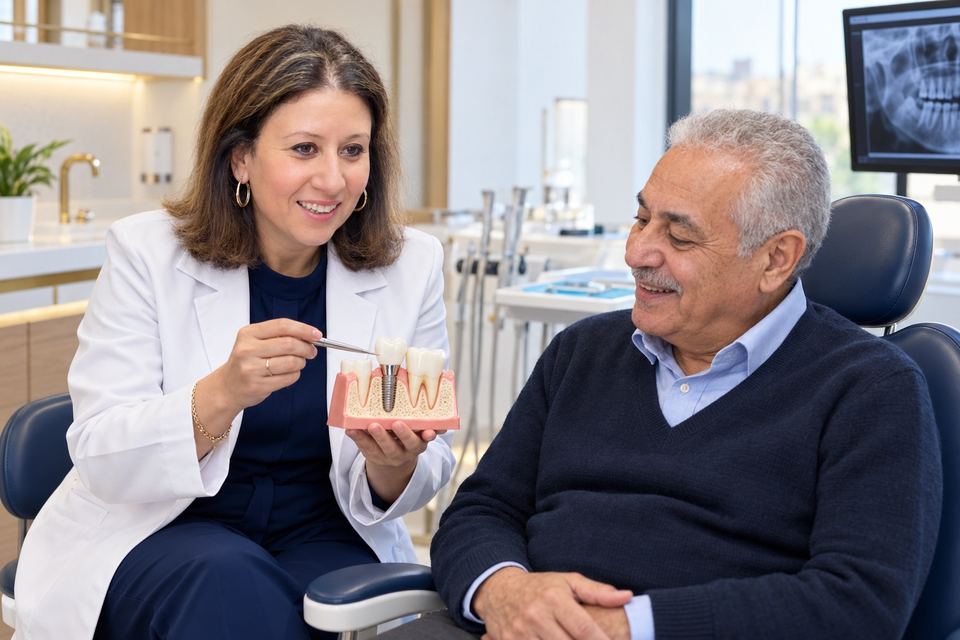
Losing a front tooth, or being told one cannot be saved, is one of the most upsetting things that can happen at the dentist. The first questions are almost always the same: will people notice, and will I have to walk around with a gap? The reassuring answer is that a well-planned front tooth implant can look and feel very natural, and you normally wear a temporary tooth throughout treatment.
The honest answer is that front teeth are also the most demanding place for an implant. Success here is not just about the implant bonding to bone; it is about the gum line, the bone thickness and how the crown matches the teeth next to it.
Why are front tooth implants different from back teeth?
- Thin bone. The bone over the front of upper front teeth is often very thin, and it can shrink quickly after an extraction.
- The gum line is on show. Even a 1 mm difference in gum height or a lost triangle of gum between teeth can be noticeable when you smile.
- Colour and translucency. The crown must match neighbouring natural teeth, and thin gum can let a grey shadow of the metal show through.
- Your smile line. If your gum shows when you smile broadly, the margin for error is smaller.
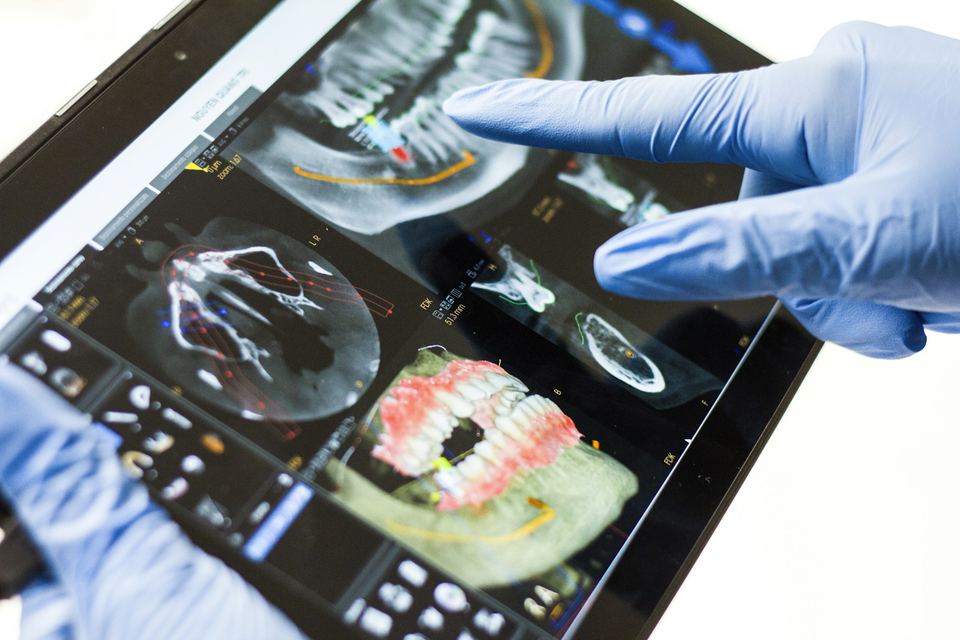
This is why a front tooth implant is usually planned with a 3D scan, photographs and careful assessment of the gum thickness before anything is removed.
Temporary tooth while the implant heals: what are the options?
| Option | What it is | Advantages | Drawbacks |
|---|---|---|---|
| Removable plate (flipper) | A small acrylic plate with one tooth | Quick, inexpensive, easy to adjust | Moves when eating, covers the palate, must not press on the healing site |
| Clear retainer with a tooth | A thin clear tray over your teeth holding a tooth | Keeps pressure off the implant site, good for short periods | Not for eating, can affect speech |
| Bonded temporary bridge (Maryland type) | A tooth bonded to the back of the neighbouring teeth with small wings | Fixed, no cutting of the neighbours in most cases | Can debond, needs a careful bite check, harder to clean under |
| Fixed temporary crown on the implant | A temporary crown attached to the implant on the day of surgery or soon after | Looks natural, shapes the gum during healing, easy to clean | Only when the implant is very stable, no major grafting, and the tooth can be kept out of the bite |
A fixed temporary on the implant has a special advantage at the front: it supports the gum and helps shape it around a natural tooth-like contour while you heal. The Cleveland Clinic notes that a temporary tooth may be worn for front implants during healing (Cleveland Clinic: dental implants).
Immediate vs delayed front tooth implant: which is better for me?
An immediate implant is placed on the same day the tooth is removed. It can mean fewer surgeries and, in suitable cases, a temporary tooth the same day. Survival rates for immediate and early placement are similar in reviews, but the gum line at the front of an immediate implant is more likely to recede, especially when the gum is thin, the bone wall is damaged, or the implant is positioned too far forward (Chen and Buser, 2009).
So immediate placement suits patients with an intact bone wall, thicker gum and no active infection. When those conditions are not met, waiting 6–8 weeks for the gum to heal, or rebuilding bone first, often gives a more predictable appearance. Our page on immediate implants and same-day teeth explains suitability in more detail.
How long does a front tooth implant take?
- Assessment: examination, photos, 3D scan, and a plan for the temporary tooth.
- Extraction and implant: same day (immediate) or after about 6–8 weeks of healing, sometimes with a bone or gum graft.
- Healing with a temporary: typically 3–6 months; longer if bone was rebuilt separately.
- Shaping the gum: the temporary crown may be adjusted to guide the gum contour.
- Final crown: shade matching, try-in, and fitting, often with a tooth-coloured (zirconia) connector to reduce the risk of a grey shadow.
For visit-by-visit detail, see dental implant stages and sessions.
Front tooth implant vs bridge
A conventional bridge replaces the tooth by crowning the two neighbours, which means filing down healthy enamel. A resin-bonded (Maryland) bridge needs little or no drilling and can be a good long-term option for some people, especially young patients or when the neighbouring teeth are healthy and the bite is light. An implant leaves the neighbours untouched and can last many years with good care, but it involves surgery and time. Our comparison of implants vs bridge vs denture covers the trade-offs, and our crowns and bridges page explains the bridge options.
Who is a front tooth implant not right for, and what are the risks?
When to wait or choose another option
- Teenagers and young adults still growing: an implant does not move with the growing jaw and can end up looking short. A bonded bridge or removable tooth is usually used until growth has finished.
- Active gum disease or infection that must be treated first.
- Severe bone loss at the front, which needs grafting before or with the implant.
- Heavy smokers, who have a higher risk of gum recession and failure.
- Strong grinding or a deep bite that places heavy forces on front teeth, which needs careful planning.
Risks specific to front tooth implants
Besides the general risks of any implant, the main concerns at the front are cosmetic: gum recession exposing the edge of the crown, a grey shadow through thin gum, a missing gum triangle between teeth (a dark space), or a crown that looks longer than its neighbour. Careful positioning, bone and gum management, and a well-shaped temporary reduce these risks but cannot remove them entirely.
How Prof. Nouran plans a front tooth implant
With a front tooth, the patient's real worry is not the surgery; it is going to work, a wedding or a family photo with a gap or a tooth that looks obviously fake. Prof. Nouran is a Professor of Prosthodontics and Dental Implants at Cairo University. As a prosthodontist, her starting point is the tooth people will see: its shape, length, shade and gum line. The implant position and the temporary are planned around that, so you know before the extraction what you will be wearing on the way out.
If an implant is not the most sensible option for your front tooth right now, she will explain the alternatives honestly. Send a smiling photo and your X-ray on WhatsApp, and we will tell you which options are worth discussing at your visit.
Recognise yourself in this?
Send us a message or a photo of your X-ray on WhatsApp. Prof. Nouran will look at your case and give you a clear plan, with no pressure to start.