Short answer
Neither is better for everyone. A fixed option (a bridge on your own teeth, or a full-arch bridge on 4–6 implants) feels closest to natural teeth but needs enough bone, good health and a bigger budget. A removable denture costs less and is easier to clean and repair. For many people, a denture held by 2–4 implants is a stable middle ground.

Most people asking this question are tired of a denture that moves when they eat or talk, and want to know whether "something fixed" would end that. The honest answer: a fixed solution usually feels closest to having your own teeth back, but it is not automatically the right choice. It depends on how much bone you have, your general health, how easily you can clean, how your face is supported, and your budget.
A removable denture is not a second-class option either. For many people, especially when it is held by implants, it gives excellent stability at a much lower cost and is simpler to look after.
What does "fixed denture" (طقم ثابت) actually mean?
In Egypt, the phrase is used for three quite different things, which is one reason quotes are so confusing:
- A bridge on your own teeth: one or a few missing teeth replaced by crowns cemented on the neighbouring teeth. Only possible when strong teeth remain on both sides of the gap.
- A fixed full-arch bridge on implants (often called All-on-4, All-on-6 or a hybrid denture): a full set of teeth screwed onto 4–6 implants. You cannot take it out; only the dentist can.
- An implant-retained overdenture (a "snap-on" denture): some people call it fixed because it no longer slips, but it clips onto 2–4 implants and you remove it yourself to clean it.
Before comparing prices, always ask which of these three you are being offered.
Fixed vs removable dentures: side-by-side comparison
| Conventional removable denture | Implant overdenture (snap-on) | Fixed implant bridge (All-on-4/6) | |
|---|---|---|---|
| Who removes it | You | You | Only the dentist |
| Stability when eating | Fair; lower dentures often move | Much better; no adhesive usually needed | Closest to natural teeth |
| Implants per jaw | None | Usually 2 (lower) to 4 (upper) | Usually 4–6 |
| Bone needed | Least | Moderate | Most, or grafting / special techniques |
| Cleaning | Easy, out of the mouth | Easy, plus cleaning around attachments | Harder; brushes and water flosser under the bridge |
| Lip and cheek support | Good, via the pink flange | Good, via the pink flange | Can be limited if a lot of bone has been lost |
| Typical Cairo cost per jaw (Oct 2026 listings) | About 5,000–20,000 EGP | Roughly 35,000–110,000 EGP (2 implants) to 160,000 EGP (4 implants) | About 80,000 to over 200,000 EGP |
| Typical maintenance | Relines; replacement every 7–10 years | Attachment inserts replaced periodically; relines | Professional cleaning and checks; repairs of teeth if chipped |
Costs depend on an examination; see denture cost in Egypt for what changes them.
Is a fixed denture better than a removable one?
Advantages of fixed teeth
- They do not move, click or need adhesive, so most people chew and speak with more confidence.
- There is no plate covering the palate, which helps taste and comfort.
- They feel like part of you rather than something you put in.
Advantages of removable dentures
- Lower cost, fewer or no surgical steps, and suitable for more people.
- Easy to clean thoroughly, which matters as hand strength or eyesight changes with age.
- The pink acrylic can rebuild lost lip and cheek support, which a fixed bridge sometimes cannot do as well.
- Easier and cheaper to reline, repair or add a tooth to.
What if I still have some of my own teeth?
When only a few teeth are missing, the choice is usually between a bridge on the neighbouring teeth, one or more implants, or a removable partial denture. A bridge means shaping the teeth on either side, which is reasonable if they already have large fillings or crowns, and less attractive if they are healthy. A partial denture avoids cutting teeth but rests on them and on the gums, so it must be designed carefully to avoid loosening them over time. Our guide to implants vs bridge vs denture compares these in detail.
Can I get a full denture that is fixed?
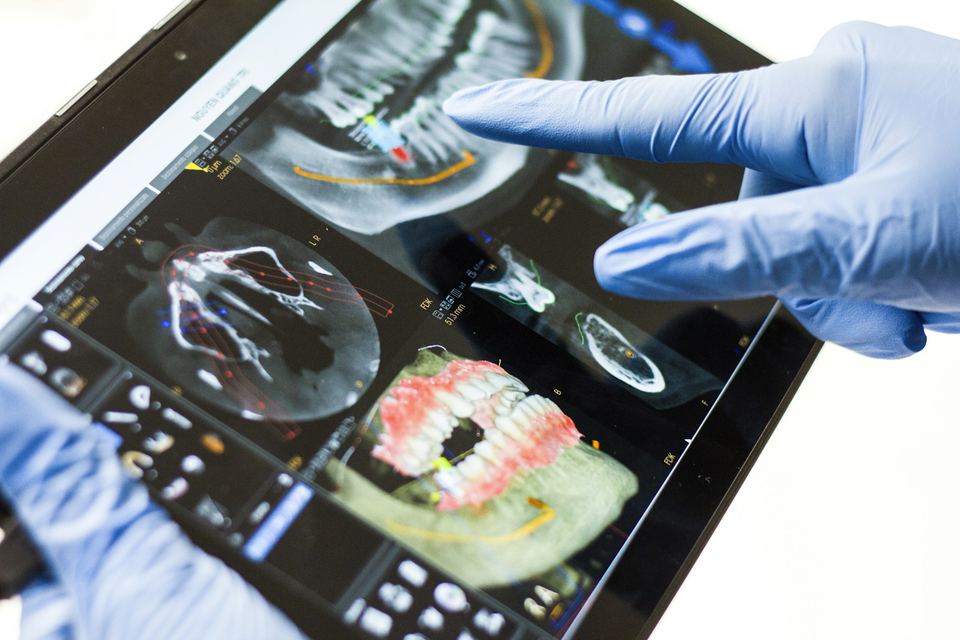
Yes, if you are suitable for implants. A fixed full-arch bridge usually needs 4–6 implants per jaw, enough bone (or a technique to work around missing bone), healthy gums and well-controlled general health. The upper jaw often needs more implants than the lower because its bone is softer. You can read how the main designs differ in All-on-4 vs All-on-6, and the treatment itself on our full-mouth implants page.
Who is a fixed option not right for?
- People with uncontrolled diabetes, heavy smoking, recent radiotherapy to the jaw or certain bone medications, until these are assessed with their physician.
- Anyone who will find it hard to clean under a fixed bridge every day, for example because of arthritis or limited mobility.
- People who have lost a lot of bone and rely on the denture flange to support their lips; a removable overdenture may give a more natural face.
- Anyone who would have to stretch their budget so far that follow-up care becomes unaffordable.
Why a "snap-on" denture is often the sensible middle ground
An international consensus statement from McGill University (2002) recommended the two-implant overdenture as the first-choice standard of care for people with no lower teeth (McGill consensus, PubMed). It turns a loose lower denture into one that stays put, with fewer implants and less cost than a fixed bridge. Like any implant treatment, it needs maintenance, mainly replacing small wear parts in the attachments. Cleveland Clinic describes the same choice between removable implant-retained and non-removable implant-supported dentures. Our explainer on implant-retained overdentures covers how they work.
How Prof. Nouran helps you decide
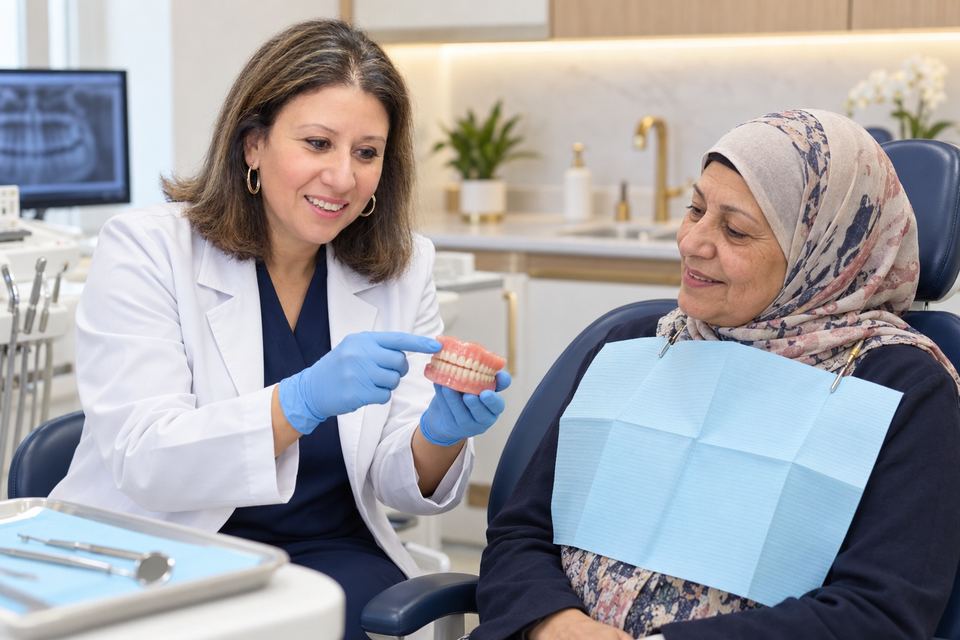
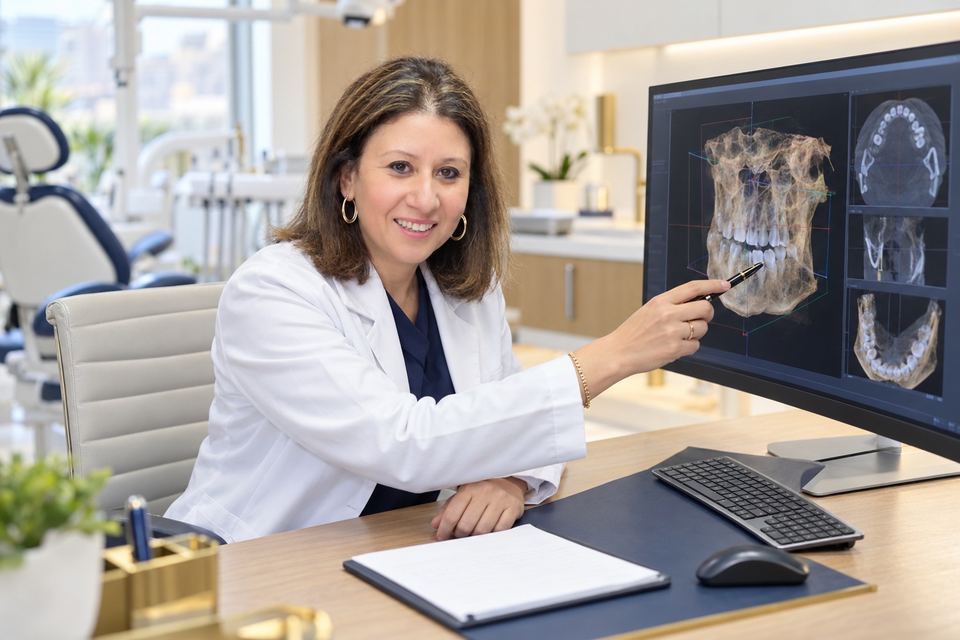
Choosing between fixed and removable is exactly the kind of decision a prosthodontist is trained for. Prof. Nouran is a Professor of Prosthodontics and Dental Implants at Cairo University and has published research on implant-retained overdentures, so she plans from the final teeth backwards: how you want to eat, smile and clean, how much bone you have, and what your face needs for support.
She examines you personally and explains each realistic option, including the simpler ones, with a written plan and estimate so you can compare calmly. If you would like to start with a first opinion, send your X-ray or a photo of your current denture on WhatsApp.
Recognise yourself in this?
Send us a message or a photo of your X-ray on WhatsApp. Prof. Nouran will look at your case and give you a clear plan, with no pressure to start.