Short answer
There is no upper age limit for dental implants. Studies of patients over 65 report implant survival of about 96% after five years, similar to younger adults. What matters is general health, medications, bone and the ability to clean. For many older people, a lower denture held by two implants is a gentle, effective option.

There is no upper age limit for dental implants. Many people in their 70s and 80s have implants placed successfully. What decides whether implants are right for you is not your birthday but your general health, your medications, the bone in your jaw and how easily you can keep the implants clean.
Many older patients live with a lower denture that moves when they eat or talk, avoid meat and raw vegetables, or feel embarrassed to laugh at family gatherings. Others are told by relatives that they are "too old for that now". The honest answer is more hopeful, and also more careful, than either extreme.
Is there an age limit for dental implants?
There is a minimum age, not a maximum. Implants are usually not placed until the jaws have finished growing, typically in the late teens or early twenties. After that, age alone is not a reason to say no.
A systematic review of implant treatment in people aged 65 and over reported implant survival of about 96% after five years, and concluded that implants are a predictable option for older patients (review of implants in the elderly, PubMed). The studies were small, so the results are encouraging rather than a promise, but they match what clinicians see in practice.
Are dental implants safe for elderly patients?
For a healthy older adult, placing one or two implants is usually a relatively minor procedure under local anaesthetic, often comparable to a surgical tooth extraction. The extra care with age comes from what tends to come with it:
- More medications, such as blood thinners, blood pressure tablets or bone-strengthening medicines, which need to be reviewed before surgery.
- Conditions that affect healing, such as diabetes. Well-controlled diabetes is usually compatible with implants; see dental implants for diabetics.
- Thinner jawbone after years without teeth, which may need shorter implants, a graft, or a design that uses fewer implants.
- Hand strength and eyesight, which affect how easily implants can be cleaned every day.
- Stamina for longer appointments, which is why treatment is often split into shorter visits.
What are the options for seniors in their 60s, 70s and 80s?
There is no "senior package". The right option depends on health, bone, budget and what you want to be able to eat. As a general guide:
| Situation | Options often considered |
|---|---|
| Healthy, active, 60s or 70s, some teeth missing | Single implants or implant bridges, much as for a younger adult. |
| No teeth in one jaw, good health and enough bone | Fixed full-arch teeth on 4–6 implants, or a removable implant denture. |
| Older age, several medical conditions, or limited bone | A lower denture held by two implants (overdenture), with less surgery. |
| Frail, very limited mobility, or surgery not advised by the physician | A carefully made conventional denture, relined when needed. |
Fixed full-arch treatment is explained on our full-mouth implants page, and well-made conventional dentures on our dentures page.
Why a denture on two implants is often the gentle option
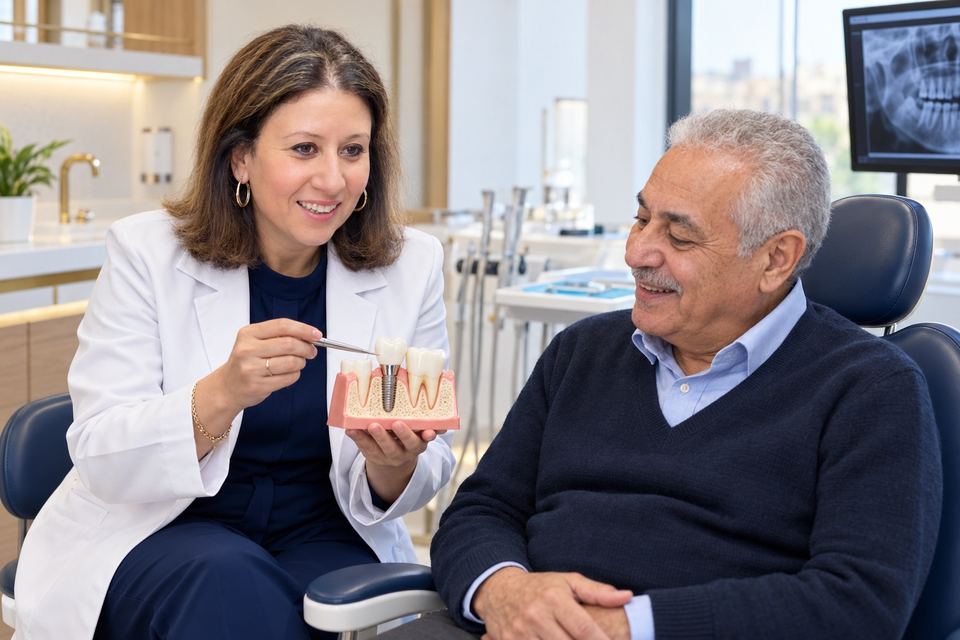
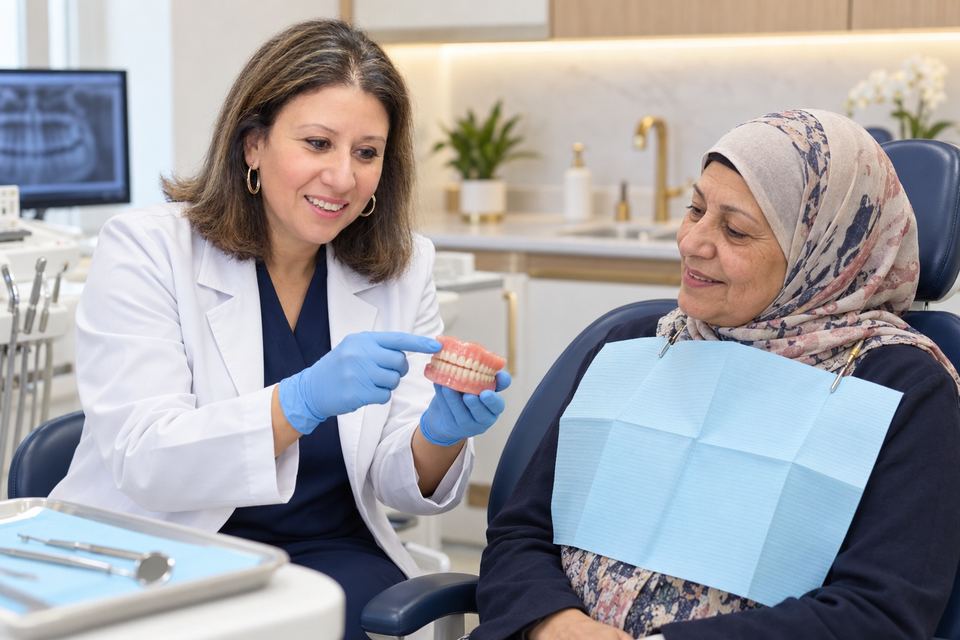
For an older person with no lower teeth, the lower denture is usually the problem: it sits on a narrow ridge of bone and the tongue and cheeks push it around. Placing just two implants in the front of the lower jaw and clipping the denture onto them can make a big difference to stability and chewing confidence.
An international consensus statement from McGill University recommended the two-implant lower overdenture as the first-choice standard of care for people with no lower teeth (McGill consensus, PubMed). For seniors it has practical advantages:
- Less surgery than fixed full-arch teeth, usually in the front of the jaw where bone is often adequate.
- The denture comes out for cleaning, which is easier for older hands or for a family member who helps.
- In some cases, an existing good denture can be adapted to clip onto the implants.
- Generally a lower cost than fixed full-arch treatment.
How it works and the attachment types are explained in what is an implant-retained overdenture?
Implants or a new denture for an older patient?
A new, well-fitting conventional denture is still a sensible choice for many people, especially when surgery is not advised or the upper denture is the only one and it already fits well. Upper dentures often hold better than lower ones because they cover the palate.
Implants tend to make the most difference when a lower denture keeps moving despite being well made, when sore spots and adhesive have become a daily routine, or when the person wants to eat a wider range of foods again.
Health checks before implants in older age
- A full medical history and list of every medication, including eye drops and injections given once a year.
- A check of blood pressure and, for people with diabetes, a recent HbA1c.
- Advice from the physician or cardiologist when there is a recent heart event, a valve replacement or a blood thinner.
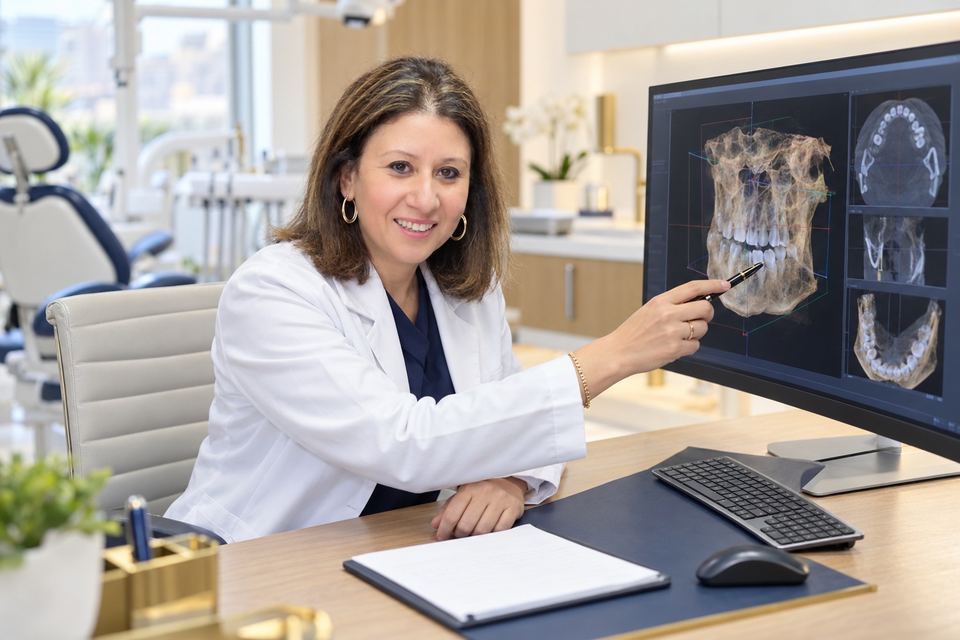
- A 3D scan (CBCT) to measure the bone and plan the shortest, simplest surgery.
- An honest talk about who will help with cleaning if hands or eyesight become weaker in the future.
Planning for the years ahead
A good plan thinks ten years ahead. If memory or mobility may decline, a removable implant denture that a caregiver can take out and clean is often wiser than a complex fixed bridge.
When implants are not advised for a senior
- Recent heart attack or stroke, until the physician agrees surgery is safe.
- Uncontrolled diabetes or other unstable medical conditions.
- Past radiotherapy to the jaw, or certain bone medicines given by injection for cancer, which need specialist assessment.
- Severe frailty, where the burden of surgery outweighs the benefit.
- No realistic way to clean the implants every day, alone or with help.
In these situations a carefully made conventional denture is often the safer choice, and that is a perfectly good outcome.
How Prof. Nouran approaches implants for older patients
Older patients often tell us they want to eat comfortably, stop worrying about a denture slipping, and avoid long, exhausting treatment. Prof. Nouran is a Professor of Prosthodontics and Dental Implants at Cairo University, and her published research focuses on implant-retained overdentures. That means she can explain the real options for a loose lower denture, with one, two or more implants and different attachment types, and their honest trade-offs.
At El Nabi Dental Clinic in Maadi she examines each patient personally and gives a written plan and estimate, so you and your family can decide calmly. If a simple new denture is the right answer, she will say so. If you would like an opinion first, a family member can send a photo of the current denture or any X-ray on WhatsApp, and we will suggest the first step.
Recognise yourself in this?
Send us a message or a photo of your X-ray on WhatsApp. Prof. Nouran will look at your case and give you a clear plan, with no pressure to start.