Short answer
Usually not. Most dental implants are placed under local anaesthetic: you stay awake, but the area is thoroughly numbed, so you typically feel pressure rather than pain. Sedation can help very anxious patients relax, and general anaesthesia is reserved for specific cases, such as extensive surgery or severe phobia, and is given in a hospital setting with an anaesthetist.

Usually not. Most dental implants are placed under local anaesthetic, the same kind of numbing injection used for a filling or an extraction, only given more thoroughly. You stay awake and can talk and signal, but the gum and bone are numb, so you typically feel pressure and vibration rather than pain.
Many people searching for "general anaesthesia for implants" are really asking something else: "Will I be able to cope?" If fear is what is holding you back, this page explains the options honestly, including when being put to sleep makes sense and when it adds risk without real benefit.
Do you get put to sleep for dental implants?
For a single implant or a few implants in healthy bone, local anaesthetic is the normal and sufficient choice almost everywhere. The surgery itself is often shorter than people expect, and because bone has relatively few pain receptors, it is usually well controlled with local numbing alone.
Clinical references describe three options for implant surgery: local anaesthesia, sedation and general anaesthesia (Mayo Clinic: dental implant surgery). The choice depends on the extent of surgery, your medical history and how anxious you are, not on a fixed rule.
Local anaesthetic vs sedation vs general anaesthesia
| Type | What it is | Are you awake? | When it is typically used |
|---|---|---|---|
| Local anaesthetic | An injection that numbs the area being treated | Yes, fully awake but numb | Most implant surgery, including many multiple-implant cases |
| Inhalation sedation | A calming gas breathed through a small nose mask, with local anaesthetic | Yes, relaxed and calm | Mild to moderate anxiety |
| Oral or IV sedation | A calming medicine by mouth or into a vein, with local anaesthetic | Deeply relaxed; many remember little afterwards | Strong anxiety, longer procedures; needs trained staff, monitoring and an escort home |
| General anaesthesia (full anaesthesia) | Medicines that make you fully unconscious | No | Severe phobia, extensive surgery, some medical or special needs; given in a hospital or day-surgery unit by an anaesthetist |
NHS sedation guidance describes the same range: local anaesthetic keeps you awake; inhalation, oral and IV sedation make you relaxed or sleepy; and general anaesthesia, which carries more risk, is reserved for people who cannot have sedation or need a lot of treatment (NHS: sedation options for dental treatment).
What does local anaesthetic feel like during implant surgery?
- A numbing gel is often placed on the gum first, so the injection is felt as a small pinch.
- The anaesthetic is given slowly in a few spots around the area. Within minutes your lip, gum and nearby teeth feel thick and numb.
- The dentist checks the area is fully numb before starting. If you feel anything sharp at any point, you raise your hand and more anaesthetic is given.
- During surgery you feel pressure, vibration and hear instrument sounds, but not sharp pain.
- Numbness usually lasts a few hours afterwards. Taking your first pain reliever before it wears off makes the evening more comfortable.
For what recovery feels like day by day, see do dental implants hurt?
When is sedation or general anaesthesia considered?
- Severe dental phobia that has kept someone away from the dentist for years.
- A strong gag reflex that makes long procedures very difficult.
- Extensive surgery, for example several implants with bone grafting in one long session.
- Certain medical conditions or special needs that make cooperation under local anaesthetic difficult.
What general anaesthesia involves
General anaesthesia (often called full anaesthesia) needs a medical assessment beforehand, fasting for several hours, an anaesthetist who monitors your breathing and heart throughout, and a hospital or day-surgery setting equipped for it. You need someone to take you home and stay with you, and you will feel drowsy for the rest of the day. It also adds cost, because of the anaesthetist and the operating room.
Is general anaesthesia safer or less painful for implants?
Not necessarily. Being asleep removes the experience of the procedure, but it does not reduce soreness afterwards; recovery from the implant surgery itself is the same. General anaesthesia also carries its own risks, which are small in healthy people but real, and higher in people with heart or lung conditions.
For most patients, a well-numbed local anaesthetic, a clear explanation and a calm, unhurried appointment is the safer and simpler route. Sedation or general anaesthesia is a useful tool for the minority who genuinely need it, not an upgrade for everyone.
Tips if you are afraid of the dentist
- Say it at the consultation. Fear is common and nothing to be embarrassed about; it changes how the appointment is planned.
- Ask for the steps in advance. Knowing what happens next reduces anxiety more than anything else.
- Agree a stop signal, such as raising your left hand, and expect it to be respected.
- Eat a normal meal before a local anaesthetic appointment unless told otherwise; low sugar makes anxiety worse.
- Bring headphones and music or a podcast to block out instrument sounds.
- Split the treatment into shorter visits if long sessions worry you.
- Practise slow breathing: breathe in for four counts, out for six, during the injection and whenever you feel tense.
Tell your dentist before any anaesthetic if you have
- heart disease, high blood pressure or a pacemaker;
- diabetes, asthma or breathing problems;
- a previous reaction to a dental anaesthetic;
- pregnancy or the possibility of pregnancy;
- blood thinners or any regular medicines.
These rarely prevent treatment, but they help the dentist choose the right anaesthetic and amount.
How Prof. Nouran keeps implant treatment calm
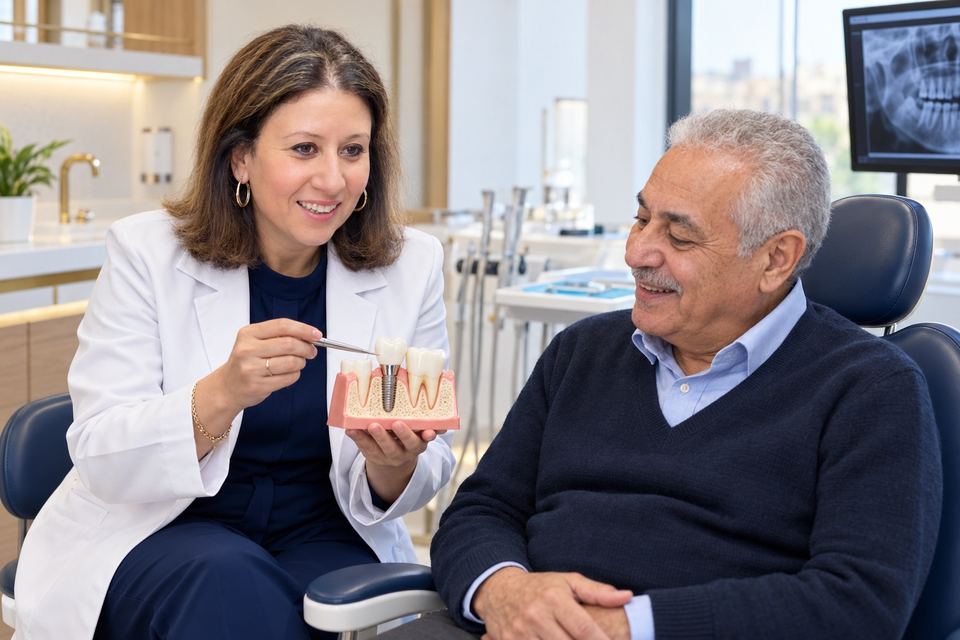
Many anxious patients have had a rushed or painful experience in the past, and that memory makes the next visit harder. At El Nabi Dental Clinic in Maadi, Prof. Nouran, a Professor of Prosthodontics and Dental Implants at Cairo University, plans the surgery in advance from your examination and scans, so the procedure is as short and precise as possible. Before anything starts, she explains each step and what you will feel, and she pauses whenever you signal.
If your case or your anxiety means sedation or general anaesthesia would genuinely be safer, she will discuss that openly and explain how and where it can be arranged. You can read about each stage on our dental implants page. If fear is what has stopped you, message us on WhatsApp or through the contact page; a calm first conversation is a good place to start.
Recognise yourself in this?
Send us a message or a photo of your X-ray on WhatsApp. Prof. Nouran will look at your case and give you a clear plan, with no pressure to start.