Short answer
You are usually a good candidate for dental implants if you are an adult whose jaw has stopped growing, your gums are healthy or treatable, you have enough bone (or can have it rebuilt), and your general health allows minor oral surgery. Uncontrolled diabetes, heavy smoking, some bone medications and jaw radiotherapy need careful assessment.

Most adults who are missing one or more teeth can be considered for dental implants. You are usually a good candidate if your jaw has finished growing, your gums are healthy or can be treated, you have enough bone to hold the implant (or it can be rebuilt with grafting), and your general health allows a minor surgical procedure. Being older is not, by itself, a reason to rule implants out.
Some medical conditions and habits do raise the risk of problems, and in a few situations an implant is not the safest choice. The only way to know for certain is an examination with X-rays and often a 3D scan, but the guide below will give you a realistic picture before you come in.
The four things every implant assessment checks
1. Bone quantity and quality
An implant needs to be surrounded by bone, both in height and in width. After a tooth is lost, the bone that held it gradually shrinks, most quickly in the first months. In the upper back jaw, the sinus can also expand downwards. A cone-beam CT scan shows exactly how much bone there is. If it is thin or short, a bone graft or sinus lift may make an implant possible, or shorter or angled implants may be used.
2. Gum health
Active gum disease (periodontitis) must be treated before implants are placed, because the same bacteria can attack the bone around an implant. People who lost teeth to gum disease can still have implants, but they need excellent home care and more frequent maintenance.
3. General health and medications
Implant placement is usually a minor procedure under local anaesthetic, so most healthy adults and many people with well-managed medical conditions can have it. Your dentist will ask about heart conditions, blood thinners, diabetes, osteoporosis treatment, cancer treatment and any immune conditions.
4. Your bite and habits
Heavy grinding or clenching, very limited mouth opening, or an unusual bite can affect the design. These rarely rule implants out, but they shape the plan.
Conditions that need extra care
| Situation | Does it rule out implants? | What usually happens |
|---|---|---|
| Well-controlled diabetes | Usually no | Proceed with good blood sugar control and close follow-up |
| Uncontrolled diabetes | Often postponed | Improve control first; higher infection and failure risk |
| Smoking | Not always, but risk is higher | Stopping or cutting down is strongly advised before and after |
| Active gum disease | Postponed | Treat the gums first, then reassess |
| Osteoporosis tablets (bisphosphonates) | Needs individual assessment | Discussion with your doctor about type and duration of treatment |
| IV bone medications or jaw radiotherapy | Often a strong caution | Specialist assessment; alternatives frequently preferred |
| Blood thinners | Usually no | Planned in coordination with your doctor; never stop them on your own |
| Pregnancy | Postponed | Elective surgery is usually delayed until after pregnancy |
This table is a general guide, not a diagnosis. Every case is assessed individually, and your medical doctor's input may be needed.
Is there an age limit for dental implants?
There is a lower limit but not really an upper one. Implants are generally not placed until the jaw has stopped growing, which is usually in the late teens for girls and around the early twenties for boys. At the other end, many patients in their seventies and eighties have implants successfully. What matters more than age is general health, healing ability and the ability to keep the implant clean.
For older patients who wear a full lower denture, two implants holding the denture in place (an implant-retained overdenture) can be a smaller procedure than a full fixed bridge and often makes a large difference to comfort and confidence.
What if I have been told I don't have enough bone?
This is common, especially if teeth were lost years ago or a denture has been worn for a long time. The options usually include:
- Bone grafting to rebuild width or height before or during implant placement.
- Sinus lift in the upper back jaw to create room for an implant.
- Shorter or narrower implants where the bone allows.
- Angled implants, as used in some full-arch designs, to avoid grafting.
- A non-implant solution, such as a well-made denture or bridge, if surgery is not appropriate.
When implants may not be the right choice
Being honest about this is part of good care. An implant may not be the safest choice if you have had high-dose radiotherapy to the jaw, take intravenous bone-strengthening drugs for cancer, have a medical condition that makes surgery risky, or are unable to clean around the implant. In these cases a bridge or denture can still restore appearance and chewing well. Our comparison of implants, bridges and dentures explains the alternatives.
What happens at an implant assessment at El Nabi
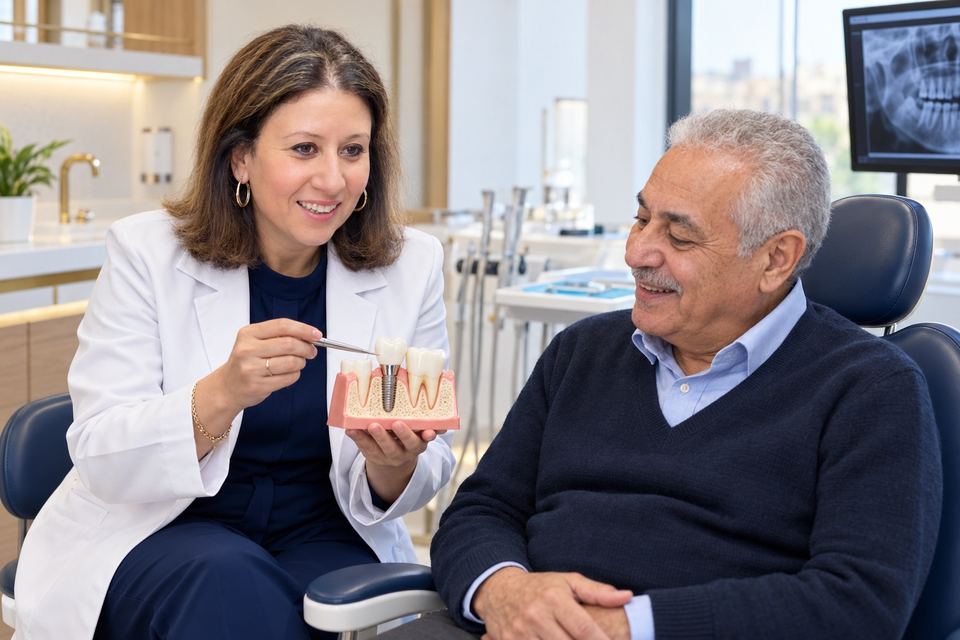
At our clinic in Maadi, Prof. Nouran Abdel Nabi begins with a conversation about what bothers you, your medical history and your expectations. We then examine your teeth, gums and bite, take X-rays, and arrange a 3D scan where the bone needs to be measured precisely.
Because Prof. Nouran's background is in prosthodontics, the plan starts from the final teeth: how they should look, how you will chew and how you will clean them. From there we decide whether implants are suitable, how many, and whether any grafting is needed. You leave with a clear explanation of the options, including non-implant alternatives, and their risks. Our dental implants page outlines the full process.
How to prepare for your assessment
- Bring a list of your medications, including doses.
- Bring any recent dental X-rays or scans.
- If you have diabetes, bring a recent HbA1c result if available.
- Write down your questions, including any concerns about pain or cost.
When to see a dentist
If you have recently lost a tooth or know one needs to be removed, an early assessment can help preserve bone and keep more options open. If you have been told elsewhere that you are not suitable, a second opinion with a 3D scan can clarify why and what alternatives exist. You can message us on WhatsApp or book through our contact page.
Recognise yourself in this?
Send us a message or a photo of your X-ray on WhatsApp. Prof. Nouran will look at your case and give you a clear plan, with no pressure to start.