Short answer
Both replace a full arch of teeth with a fixed bridge on implants. All-on-4 uses four implants, often with the back two angled to avoid grafting; All-on-6 uses six, spreading biting forces more widely and offering more backup if one implant has a problem. The choice depends mainly on available bone, jaw, bite force and budget.

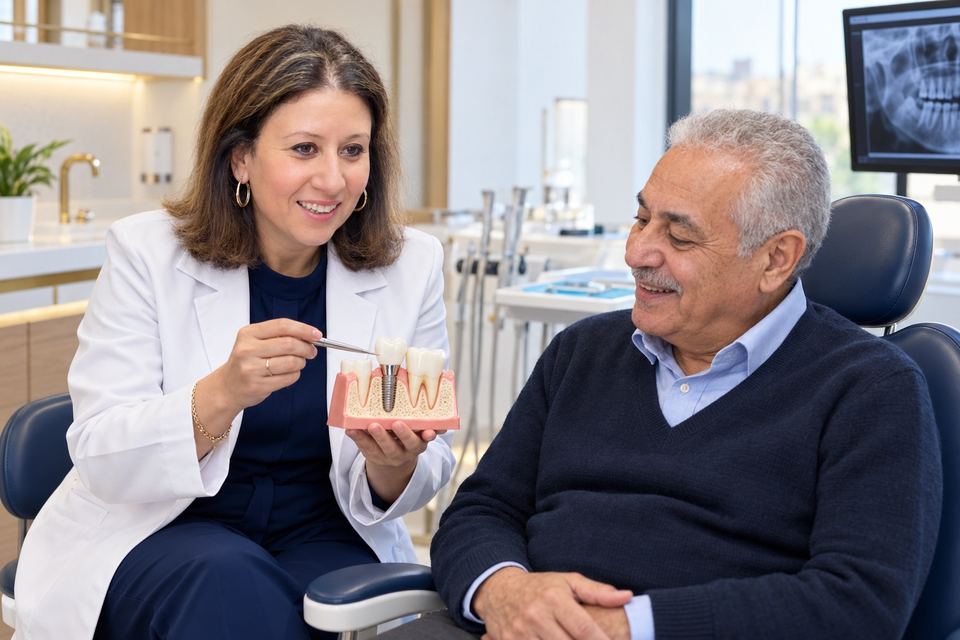
Both All-on-4 and All-on-6 are ways to replace a whole arch of teeth with a fixed bridge supported by implants. The difference is the number of implants. All-on-4 uses four implants, usually with the two back ones tilted to make use of available bone and avoid structures such as the sinus or the nerve, which can reduce the need for grafting. All-on-6 uses six implants, which spreads chewing forces over more supports and gives some reserve if one implant develops a problem. Neither is automatically better; the right design depends on your bone, your bite and your priorities.
"All-on-4" began as a specific protocol name, but today both terms are widely used to describe full-arch fixed bridges on four or six implants. Some cases use five, or eight in the upper jaw. What matters is that the number and position of implants suit your anatomy.
All-on-4 and All-on-6 side by side
| All-on-4 | All-on-6 | |
|---|---|---|
| Number of implants | 4 per arch | 6 per arch |
| Typical implant angle | Front two upright, back two tilted | Mostly upright, sometimes tilted |
| Bone needed | Can work with less bone at the back | Needs more bone along the arch, or grafting |
| Grafting | Often avoidable | More often needed, especially in the upper back jaw |
| Force distribution | Good when well planned | Wider support, more even spread |
| If one implant fails | The bridge usually cannot be used until it is replaced | The bridge may still be supported while it is replaced |
| Immediate fixed teeth | Commonly possible | Commonly possible |
| Cost | Generally lower | Generally higher |
For context, Cairo public listings as of October 2026 show full-jaw implant treatment ranging from about 40,000 to more than 200,000 EGP. The number of implants, the implant system, grafting and the final bridge material all affect where a case falls in that range. Your cost depends on an examination.
When All-on-4 is often a good fit
- Bone is limited at the back of the jaw, and tilted implants can avoid a sinus lift or nerve.
- You want to reduce the number of surgical sites and avoid or minimise grafting.
- The lower jaw, which is usually denser, provides good anchorage at the front.
- Budget is a significant factor and the bone allows four well-placed implants.
When All-on-6 is often preferred
- There is good bone along the arch, or grafting is acceptable.
- The upper jaw, where bone is usually softer, benefits from more support.
- You have strong biting forces, a large jaw or a history of clenching.
- You value having reserve support in case one implant has a problem later.
- The plan is to make the final bridge in sections, which needs more implants.
What the treatment involves
Planning
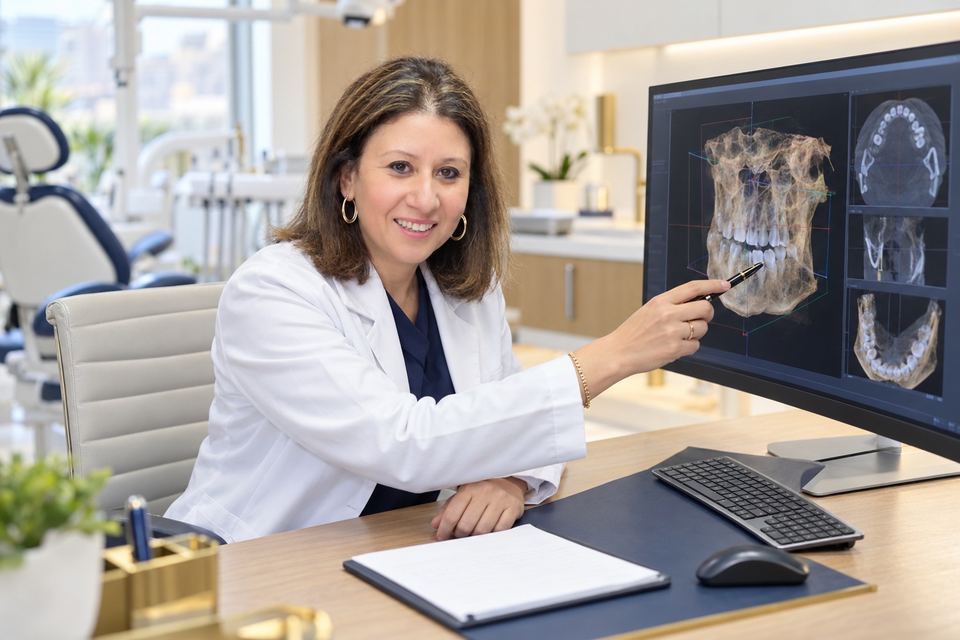
A full-arch case starts with records of your face, smile, bite and the current teeth or denture, plus a 3D scan of the jaw. The final teeth are designed first, and the implants are positioned to support them. In many cases a surgical guide is made from the scan.
Surgery day and temporary teeth
Remaining teeth that cannot be saved are removed, the implants are placed, and in suitable cases a fixed temporary bridge is attached within about one to three days. This depends on the implants being firmly stable at placement; if not, a temporary denture is used while they heal. See immediate implants and same-day teeth.
Healing and the final bridge
After about three to six months, the final bridge is made. Options include acrylic teeth on a metal or titanium framework, or zirconia. Zirconia is harder wearing and resists staining, while acrylic-based bridges are lighter, easier to repair and kinder to opposing teeth in some situations.
Risks and limitations of fixed full-arch implants
- Surgery and recovery: swelling and soreness for several days, and a soft diet for weeks.
- Peri-implantitis: infection around implants if cleaning under the bridge is neglected.
- Mechanical problems: chipped teeth, worn acrylic or loosened screws, which need maintenance.
- Speech and lip support: fixed bridges cannot always replace lost gum and bone volume as fully as a denture flange; this is assessed during planning.
- Hygiene access: you clean under the bridge with special brushes or a water flosser, and the bridge is removed by the dentist periodically for maintenance.
Who should consider alternatives
If you have uncontrolled diabetes, smoke heavily, have had radiotherapy to the jaw, or cannot clean under a fixed bridge, a fixed full arch may not be the safest choice. Some patients, especially in the lower jaw, are better served by an implant-retained overdenture, which uses two to four implants, is removable for cleaning and costs less. If a lot of bone has been lost, a removable design can also give better support to the lips and face.
How we plan full-arch implants at El Nabi
At our clinic in Maadi, Prof. Nouran Abdel Nabi plans full-arch cases from the prosthodontic side: the appearance, bite, speech and cleanability of the final teeth come first, and the number and angle of implants follow. We discuss whether four, six or another configuration suits your bone, and we present a removable overdenture option where it may serve you better.
You receive a clear plan showing each stage, the temporary teeth, the final bridge material and the maintenance it will need. Read more on our full-mouth implants page.
Questions to ask before choosing
- How much bone do I have, and will I need grafting for either design?
- What happens if one implant fails?
- What will the final bridge be made of, and how is it maintained?
- Can I have fixed temporary teeth on the day, and what if stability is not enough?
- Would an overdenture be a reasonable alternative in my case?
When to see a dentist
If you are losing most of your teeth or are frustrated with a loose denture, a full-arch assessment will show which designs are realistic for you. You can message us on WhatsApp or book through our contact page.
Recognise yourself in this?
Send us a message or a photo of your X-ray on WhatsApp. Prof. Nouran will look at your case and give you a clear plan, with no pressure to start.