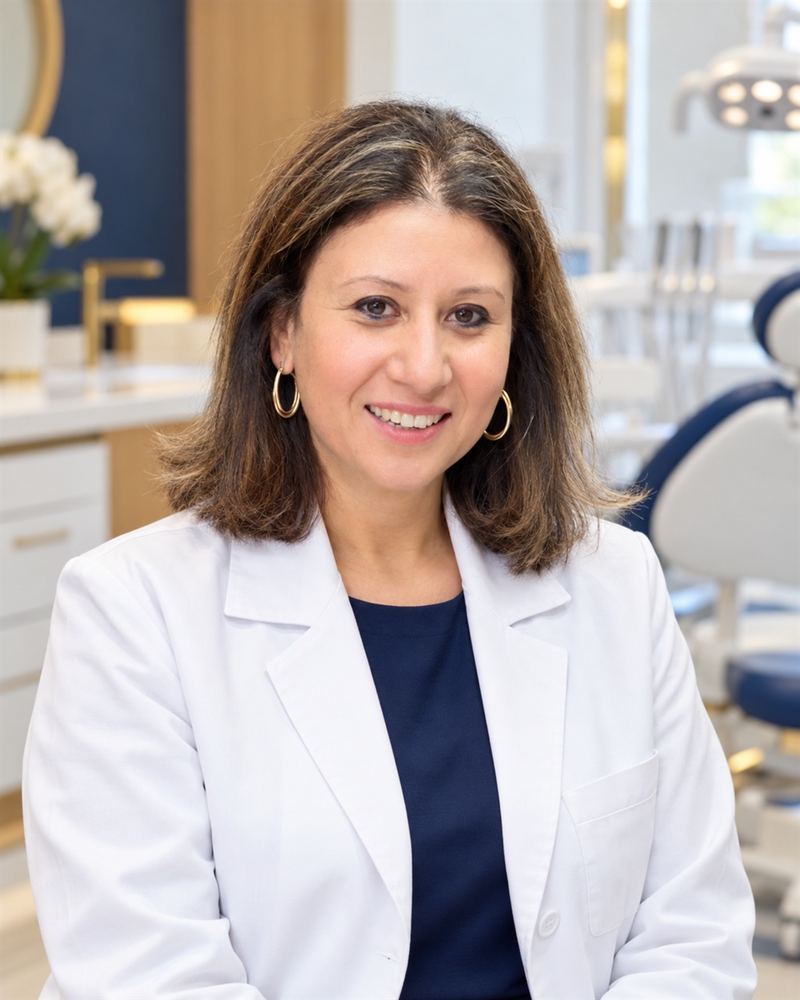
Education and academic titles
- Master's degree in ProsthodonticsCairo University
- PhD in ProsthodonticsCairo University
- Professor of Prosthodontics and ImplantologyCairo University
Patients who often come to Prof. Nouran
“My lower denture slips and I'm tired of using adhesive.”
She explains whether implants could hold your denture in place, how many you would need and what changes day to day.
“I'm missing a tooth and don't know if I need an implant or a bridge.”
She compares implant, bridge and denture options for your situation, including cost, time and how much natural tooth each one affects.
“My implant or crown from another clinic keeps failing.”
She examines what went wrong and offers a specialist second opinion, with realistic options to repair or redo the work.
“I've lost most of my teeth and want fixed teeth again.”
She plans full-arch options such as implant bridges or overdentures, and is open about who is suitable, the steps and the alternatives.
“I want a nicer smile, but I don't want fake-looking teeth.”
She designs crowns or veneers around your face and bite, and suggests conservative steps such as whitening first when they fit.
A focus on replacing missing teeth
Prof. Nouran's clinical and academic work centres on prosthodontics, the branch of dentistry that restores damaged teeth and replaces missing ones with crowns, bridges, dentures and implant-supported teeth. In the clinic, that means she spends much of her time helping people who have lost teeth eat, speak and smile comfortably again.
A large part of her research concerns implant-retained overdentures: removable dentures that clip onto a small number of dental implants instead of resting only on the gums. For many people who struggle with a loose lower denture, this is one of the most practical ways to chew with more confidence. You can read a plain-language summary in our article on implant overdenture research explained.
What a prosthodontist does, and why it matters for implants
Placing a dental implant is a surgical step, but the implant is only the foundation. What you actually use every day is the tooth, bridge or denture attached to it. Prosthodontics is concerned with that end result: how your teeth meet when you bite, how much space there is for new teeth, how your lips and cheeks are supported, and how chewing forces are spread across the jaw.
That is why planning matters. When implants are positioned with the final teeth in mind, the crown or denture can be shaped to look natural, be cleaned easily and carry forces in a healthy direction. When they are not, the result can be harder to clean, less stable or more likely to chip or loosen.
The same thinking applies across her work:
- Dental implants: from a single missing tooth to full-mouth implant options, planned around the teeth you will end up with. See dental implants.
- Crowns and bridges: choosing the material, such as zirconia or E.max, and the design according to the tooth's position and how you bite. See crowns and bridges.
- Dentures: getting the fit, bite and appearance right, and recognising when adding implants would make a real difference. See dentures and implant overdentures.
Her research, in plain words
Prof. Nouran is a Professor of Prosthodontics and Dental Implants at Cairo University. Her research has been published in peer-reviewed journals such as The International Journal of Prosthodontics, the European Journal of Dentistry and the Egyptian Dental Journal. The questions it explores are ones patients often ask in the dental chair:
- Which attachment suits which patient? An overdenture connects to its implants through small attachments, such as studs, balls or bars. Each design feels and behaves differently, and her work compares how attachment designs hold the denture and how they load the implants.
- What happens to the bone around the implants? Some change in the bone around implants is expected over the years. Measuring bone height around overdenture implants helps show which designs keep that change small.
- Can one implant steady a loose lower denture? A single implant in the front of the lower jaw is a simpler, lower-cost option for patients who cannot have two or more implants. Research helps clarify when it is reasonable and where its limits are.
- Which framework grips better in a telescopic overdenture? Telescopic overdentures use precisely fitted inner and outer caps. Her work compares frameworks made from milled zirconia and from PEEK, a strong high-performance polymer, to see how well each keeps its grip over repeated use.
Research findings do not apply to every mouth in the same way, but they help her explain realistic expectations, including how a design is likely to behave after years of chewing.
How Prof. Nouran works with patients
Every treatment starts with listening. Before anything is recommended, she wants to understand what bothers you, whether that is a denture that moves, a gap you hide when you smile or pain when chewing, and what matters to you, including budget and time.
Then comes a careful examination, with X-rays or a 3D scan where needed. She explains what she sees, sets out the options side by side and is open about the trade-offs: what each option involves, how long it typically takes, the risks, and who it is not suitable for. Sometimes the right advice is a simpler treatment, or no treatment yet.
You receive a written plan and estimate before you start, and you are welcome to take time to think, ask questions or seek a second opinion. Consultations are offered in Arabic and English.
Because good restorations depend on healthy foundations, the clinic also provides everyday care, including checkups, cleaning, tooth-coloured fillings and root canal treatment, alongside implants and prosthetic work.
Who she typically helps
- Adults missing one or several teeth who want to compare implants, bridges and dentures.
- Denture wearers whose lower denture moves when they eat or speak.
- Patients with worn, broken or heavily filled teeth who need crowns or a full-mouth plan.
- People who want a more natural-looking smile without over-treating healthy teeth.
Research themes
Attachment designs for implant overdentures: how different ways of connecting a denture to its implants affect grip, comfort and the load on the implants.
Bone height around overdenture implants: measuring how the bone supporting the implants changes over time with different designs.
Single-implant lower overdentures: when one implant in the lower jaw can make a loose denture steadier, and what its limits are.
Telescopic implant overdentures: comparing how well milled zirconia and PEEK frameworks keep their grip with repeated use.