Key takeaways
- The 2002 McGill consensus statement concluded that a two-implant overdenture should be the first-choice standard of care for the edentulous lower jaw.
- Ball, locator-type, bar and telescopic attachments all work; they differ in retention, space needed, cleaning and maintenance.
- A single midline implant in the lower jaw has shown promise in trials, but the evidence base is smaller than for two implants.
- Implants help preserve bone where they are placed, while bone at the back of the jaw may still shrink under the denture.
- Regular maintenance, mostly replacing worn retentive parts and relining, is a normal part of overdenture care.
If you have ever worn a loose lower denture, you know the problem: it lifts when you speak, shifts when you chew and makes you avoid certain foods in company. For decades, researchers have asked a simple question with a complicated answer: what is the most practical, affordable way to make a lower denture stable?
Much of that research has focused on the implant-retained overdenture, a removable denture that clips onto a small number of dental implants. This is also the field that our lead dentist, Prof. Nouran Abdel Nabi, studies as a Professor of Prosthodontics and Dental Implants at Cairo University. This article explains, in plain language, what the research has found and what it means for patients choosing treatment.
What is an implant-retained overdenture?
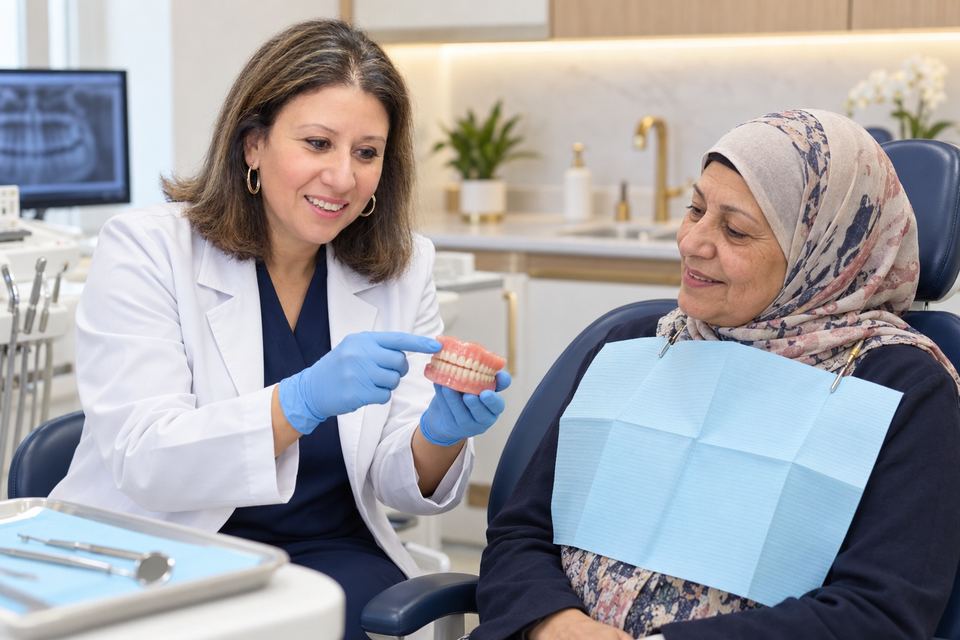
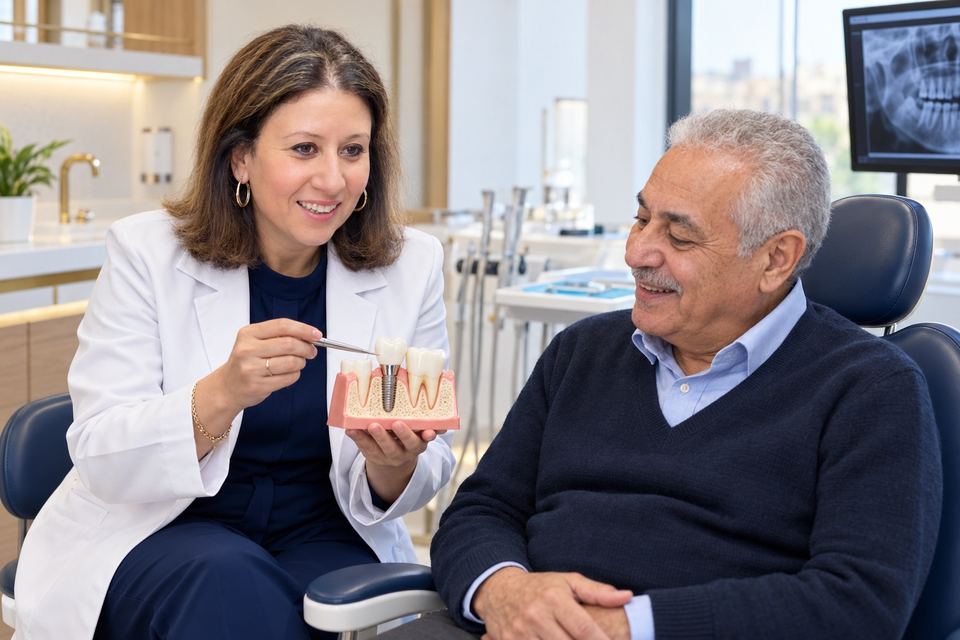
A conventional complete denture rests on the gums and relies on suction and muscle control. An implant-retained overdenture looks similar, but on its fitting surface it has small retentive parts, called attachments, that connect to matching parts on two or more implants in the jaw. The implants hold the denture in place; the gums still support part of the chewing load.
Because the denture is still removable, the patient takes it out to clean it and to clean around the implants. For a basic introduction, see our FAQ: what is an implant-retained overdenture?
The McGill consensus: why two implants became a reference point
In 2002, a group of experts meeting at McGill University in Montreal published what is now known as the McGill consensus statement on overdentures. Having reviewed the evidence available at the time, they concluded that a conventional denture should no longer be considered the most appropriate first-choice treatment for a lower jaw with no teeth. Instead, they stated that a two-implant overdenture should become the first-choice standard of care for the edentulous lower jaw.
A similar position was later reaffirmed by a consensus statement from the British Society for the Study of Prosthetic Dentistry in York in 2009.
It is worth being precise about what this means. The consensus does not say every patient must have implants, nor that two implants are always enough. It says that, for most people without teeth in the lower jaw who can have minor surgery, a two-implant overdenture offers a well-evidenced improvement over a conventional denture at a reasonable cost. Individual health, bone, budget and preference still decide the final plan.
Why the lower jaw gets so much attention
Upper dentures often fit reasonably well because they cover the palate, which creates good suction. Lower dentures have a much smaller horseshoe-shaped base, a mobile tongue and floor of the mouth, and the lower jaw tends to lose bone faster after teeth are lost. That combination is why lower dentures are the most common source of complaint and why most overdenture research focuses there.
In the upper jaw, overdentures are also used, but they usually need more implants, because upper bone is generally softer. The evidence for specific upper-jaw designs is less uniform, so planning is more individual.
Attachment types: ball, locator, bar and telescopic
The attachment is the "clip" between the implant and the denture. Much of the research, including published work by Prof. Nouran and her colleagues, compares different attachment designs. The main families are:
Ball (stud) attachments
A small ball-shaped head on the implant fits into a socket or rubber ring inside the denture. Ball attachments are simple, relatively affordable and forgiving. Their retention gradually decreases as the inner ring or metal housing wears, so the retentive part needs replacing from time to time.
Locator-type (low-profile resilient) attachments
These are short stud attachments with replaceable nylon inserts that come in different retention strengths. Their low height makes them useful where space is limited, and they can accommodate some difference in implant angle. As with ball attachments, the inserts wear and are changed periodically, which is a quick chairside procedure.
Bar attachments
A metal bar connects two or more implants, and clips in the denture hold onto the bar. Splinting the implants together gives high stability and is sometimes chosen when implants are not parallel or in the upper jaw. On the other hand, a bar needs more vertical space, is more complex and costly to make, and is harder to clean underneath; the gum under a bar can become inflamed if hygiene is not good.
Telescopic (double-crown) attachments
An inner metal or ceramic cap is fixed to each implant, and an outer cap built into the denture slides precisely over it, held by friction or a slight taper. Telescopic designs can give very good stability and are easy to clean around once the denture is removed. They are technically demanding, need a skilled laboratory and usually cost more.
Comparing the attachment options
| Attachment | Retention and stability | Space needed | Cleaning | Typical maintenance | Relative cost |
|---|---|---|---|---|---|
| Ball | Good retention; some movement allowed | Moderate | Easy | Replace rings or housings as they wear | Lower |
| Locator-type | Good, adjustable via insert strength | Low | Easy | Replace nylon inserts periodically | Lower to moderate |
| Bar | High; implants splinted together | More | Harder under the bar | Clip replacement; gum care under bar | Higher |
| Telescopic | High; precise friction fit | Moderate to more | Easy once denture is out | Checks of fit and friction | Higher |
No single attachment suits everyone. Across studies, patient satisfaction tends to be high with all of these designs when they are well planned. The choice usually depends on the space available, the angle and number of implants, the patient's hand dexterity, and budget.
One implant or two in the lower jaw?
Because cost is a major barrier, researchers have tested whether a single implant placed in the middle of the lower jaw could hold a denture well enough. Several clinical trials have reported that patients with a single midline implant were similarly satisfied in the short to medium term compared with two implants, and that it can be a reasonable lower-cost option for some people, such as older patients or those with health limitations.
However, the body of evidence for single implants is smaller and has shorter follow-up than for two implants. Concerns studied include denture fracture over the single implant and the denture rocking around one point. For this reason, two implants remain the more established standard, while a single implant is an option to discuss case by case.
What happens to the bone?
Bone changes are one of the most important long-term questions, and they are a focus of Prof. Nouran's published work, which examines bone height around overdenture implants with different attachment designs.
In general terms, the research shows:
- Around the implants: bone loss at the implant neck is usually small after the initial healing period when implants are well placed and kept clean. Attachment design and how load is shared between implants and gums are studied as possible influences.
- In the front of the lower jaw: the presence of implants appears to help preserve bone in the area where they are placed, compared with a conventional denture.
- At the back of the lower jaw: where there are no implants, the denture still rests on the gum, and some studies report continued bone shrinkage there. This is one reason relining is still needed over time.
- Opposing jaw: whether a stable lower overdenture speeds up bone loss under an upper complete denture has been debated, and findings are mixed. Careful bite design and regular checks are the practical response.
Researchers measure these changes using standardised X-rays and, increasingly, CBCT scans, comparing bone levels at fixed points over months and years.
Retention, maintenance and what patients should expect
Overdentures are not "fit and forget". Studies consistently show that maintenance is common, especially in the first year, and most of it is minor:
- replacing worn inserts, rings or clips as retention decreases;
- tightening or replacing attachment components;
- relining the denture as the gums and bone change;
- treating sore spots or adjusting the bite.
None of these usually means the treatment has failed. They are part of normal care, similar to servicing a car. Planning for them in advance, including their cost, avoids disappointment.
Patient satisfaction and quality of life
When patients who struggled with a conventional lower denture receive an implant overdenture, studies generally report better chewing ability, more comfort, more confidence in social situations, and improved oral-health-related quality of life. Many patients can return to foods they had avoided.
Satisfaction is not universal. People with unrealistic expectations, those who dislike anything removable, or those unable to clean around implants may be happier with another option, including fixed implant teeth or a well-made conventional denture. Our honest comparison of dentures or implants after 50 covers these choices.
Who may not be suited to an implant overdenture
- People who cannot safely undergo minor oral surgery because of medical conditions or medications.
- Heavy smokers, unless they can stop or significantly reduce smoking.
- Patients with very little bone who are not willing to have grafting, although overdentures often need less bone than fixed options.
- People who want teeth that never come out; a fixed full-arch option may suit them better if they are suitable for it.
How to read claims about "research" critically
Patients often hear phrases such as "research has proven" or "the latest technique". A few simple questions help separate useful information from marketing:
- Who was studied? Results in healthy 60-year-olds may not apply fully to someone with uncontrolled diabetes or very little bone.
- How long was follow-up? One-year results differ from five- or ten-year results, especially for bone and maintenance.
- One study or many? Consensus statements and systematic reviews that pool many studies usually carry more weight than a single trial.
- What was actually measured? Some studies measure retention force in the laboratory; others measure patient satisfaction or bone levels in the mouth. Each tells you something different.
A good dentist can explain what the evidence means for your situation, and where questions remain open, without exaggeration or promises.
How research shapes treatment at our clinic
At our clinic in Maadi, overdenture planning draws on this body of evidence. In practice that means examining bone with appropriate imaging, discussing the number of implants and attachment type that fit your mouth and budget, explaining expected maintenance up front, and offering alternatives where an overdenture is not the right fit. You can learn more about the treatment on our dentures and overdentures page.
Next step
If a loose denture is affecting how you eat or speak, an assessment can tell you whether an implant-retained overdenture is realistic for you, how many implants would be needed and which attachment would suit you. Book a consultation or message us on WhatsApp, and we will explain your options and give you a written plan.
Recognise yourself in this?
Send us a message or a photo of your X-ray on WhatsApp. Prof. Nouran will look at your case and give you a clear plan, with no pressure to start.