Key takeaways
- Age alone rarely rules out implants; general health, bone and habits matter far more.
- Conventional dentures are the lowest-cost option but lower dentures in particular are often loose.
- Two implants holding a lower denture is a well-researched middle ground that many patients find transforms comfort.
- Fixed full-arch implant teeth feel closest to natural teeth but cost more and demand careful cleaning.
- Bridges suit short gaps with healthy neighbouring teeth, not a mouth with few teeth left.
Many people in their fifties and sixties reach the same point: a few teeth have already been lost, others are failing, or an old denture no longer fits. Friends recommend implants, others say "at your age, a denture is fine", and the internet offers a hundred opinions.
The truth is that there is no single right answer after 50. There is the right answer for your mouth, your health, your budget and the way you live. This guide compares the four main options honestly, including who each one is not suitable for, so you can go into a consultation knowing what to ask.
Does age matter for dental implants?
Less than most people think. Implants are placed successfully in patients in their seventies and eighties. What matters more is:
- General health: conditions such as poorly controlled diabetes, recent heart problems or treatment with certain bone medications need careful assessment.
- Bone volume: after teeth are lost, the jawbone gradually shrinks. Someone who has worn a denture for twenty years may have much less bone than someone who lost teeth recently.
- Smoking: smoking is linked to higher implant failure and gum problems around implants.
- Dexterity and routine: can you clean around implants or remove and clean a denture every day?
If you want to check the basics, our FAQ on who is a candidate for dental implants is a good starting point.
Option 1: Conventional dentures
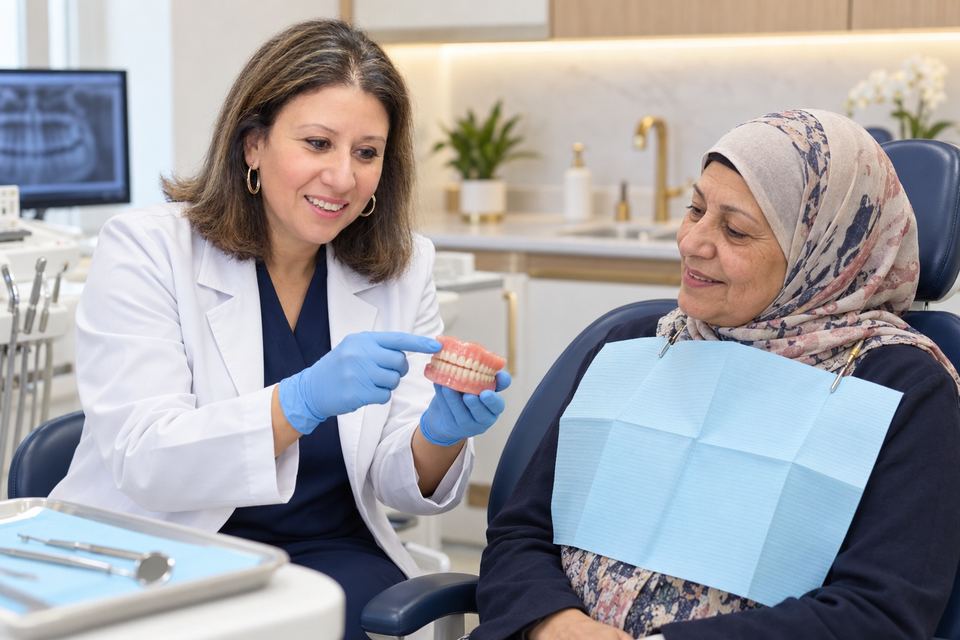
A conventional complete denture sits on the gums and is held by suction, the shape of the jaw and the muscles of the cheeks and tongue. A partial denture also clips onto remaining teeth.
Strengths: no surgery, the lowest cost, relatively quick to make, and easy to repair or adjust. Upper complete dentures often fit well because the palate gives good suction.
Limitations: lower complete dentures are frequently loose because the lower jaw has less surface area and a moving tongue. Chewing force is much lower than with natural teeth, some foods become difficult, and the bone under the denture continues to shrink over the years, so relining or remaking is needed periodically.
Often suits: patients who cannot or prefer not to have surgery, those on a tight budget, and as a temporary or transitional step. Cairo market ranges in October 2026 listings are roughly 8,000–15,000 EGP for acrylic and 10,000–20,000 EGP for chrome-based dentures. See our dentures page for materials and fitting.
Option 2: Implant-retained overdentures
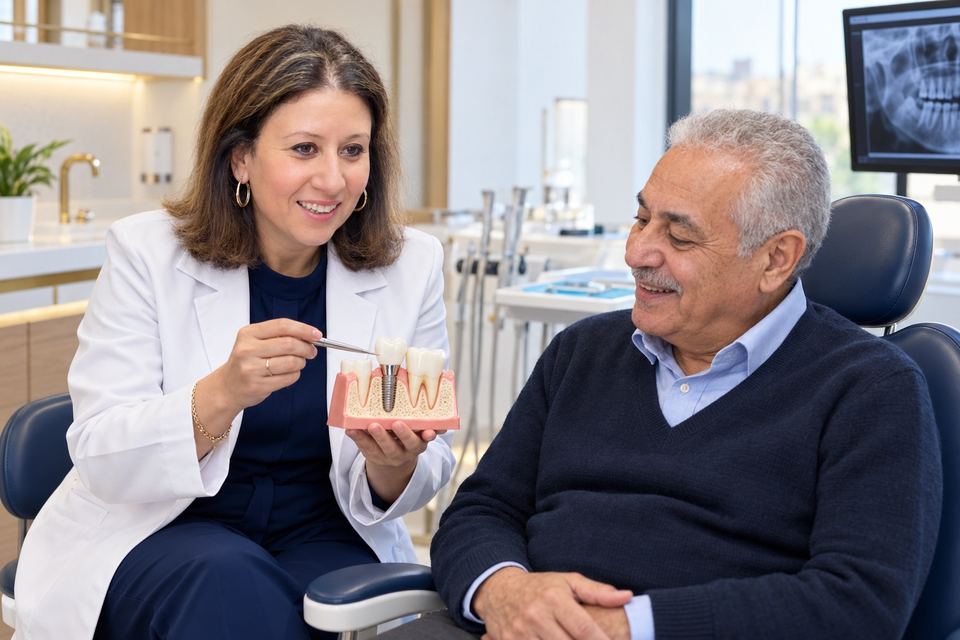
An implant-retained overdenture is a removable denture that clips onto a small number of implants, usually two in the lower jaw. The implants hold the denture in place; the gums still share some of the load.
Strengths: a big improvement in stability compared with a loose lower denture, at a fraction of the cost of fixed full-arch teeth. It needs fewer implants and can often work with less bone. The denture still comes out for cleaning, which many older patients find easier than cleaning under a fixed bridge.
Limitations: it is still removable, the clip parts (attachments) wear and need replacing from time to time, and surgery is still needed to place the implants. Research also shows that bone at the back of the jaw, where there are no implants, may continue to shrink under the denture.
Often suits: people whose main complaint is a loose lower denture, and those who want implant stability without the cost of a fixed solution. This is the area our lead dentist, Prof. Nouran Abdel Nabi, has researched and published on; we explain the evidence in what research tells us about implant-retained overdentures.
Option 3: Fixed full-arch implant teeth
Here a complete arch of teeth is screwed onto four to six implants and does not come out at home. This is often called "all-on-4" or "all-on-6" style treatment.
Strengths: it feels closest to natural teeth, there is no plate covering the palate, chewing ability is high, and many patients report it feels like "having my own teeth again".
Limitations: it is the most expensive option, typically sitting at the upper end of the Cairo full-jaw range of about 40,000–200,000+ EGP. It needs enough bone in the right places, more complex surgery and careful daily cleaning with brushes and water flossers. Professional maintenance visits are essential, and repairs are more involved than with a removable denture.
Often suits: healthy patients with adequate bone who strongly prefer fixed teeth and can commit to maintenance. Read more on the full-mouth implants page and in our FAQ on all-on-4 vs all-on-6.
Option 4: Conventional bridges
A bridge fills a gap by attaching a false tooth to crowns placed on the neighbouring natural teeth.
Strengths: fixed, no surgery, quicker than implants, and natural-feeling for short gaps.
Limitations: the supporting teeth must be shaped for crowns, and they carry extra load. If one of those teeth later fails, the whole bridge is affected. Bridges are not a solution when most teeth are missing.
Often suits: one or two missing teeth next to strong teeth that already need crowns. See crowns and bridges.
Side-by-side: which option fits your situation?
| Factor | Conventional denture | Implant overdenture | Fixed full-arch implants | Bridge |
|---|---|---|---|---|
| Relative cost | Lowest | Moderate | Highest | Moderate (per gap) |
| Surgery needed | No | Yes, usually 2 implants (lower jaw) | Yes, usually 4–6 implants per jaw | No |
| Bone needed | Works with little bone | Moderate; often feasible with reduced bone | More, in specific areas (grafting may be needed) | Depends on supporting teeth |
| Stability when eating | Low to fair (lower jaw often loose) | Good | Very good | Very good |
| Removable? | Yes | Yes | No (dentist only) | No |
| Daily cleaning | Simple | Simple, plus cleaning around 2 implants | Demanding; special brushes needed | Moderate; floss under bridge |
| Ongoing maintenance | Relines and remakes over time | Attachment parts replaced periodically | Regular professional cleaning and checks | Checks of supporting teeth |
| Health considerations | Suitable for almost everyone | Needs fitness for minor surgery | Needs fitness for longer surgery | Needs healthy neighbouring teeth |
What the evidence says about quality of life
Research comparing these options, much of it in people aged 50 and over, points in a consistent direction, although results vary between individuals:
- Patients moving from a conventional lower denture to a two-implant overdenture typically report better chewing, more confidence when speaking and eating in public, and higher satisfaction.
- The difference is usually largest in the lower jaw. Many people manage well with a conventional upper denture, so implants are not always needed in both jaws.
- Fixed implant bridges and implant overdentures both tend to score well for satisfaction. Some patients, especially those who value easy cleaning, prefer the removable option.
- Good outcomes depend on follow-up. Implants and attachments need checking, just as natural teeth do.
Quality of life is personal. A retired patient who mainly wants to eat comfortably with family may be delighted with an overdenture. Someone who gives talks or presentations may place more value on fixed teeth. Both are reasonable choices.
Risks to discuss before choosing
Every option has downsides, and an honest plan names them:
- Implant surgery: swelling, bruising and discomfort for a few days are common; less commonly, infection, nerve irritation in the lower jaw, or an implant that does not integrate.
- Peri-implantitis: inflammation of the gum and bone around implants, more likely with smoking and poor cleaning.
- Denture sores: any new denture can rub at first and need adjustment; see our guide to getting used to new dentures.
- Bridge failure: decay or gum disease under the supporting crowns.
Five questions to help you decide
- What bothers me most today: looseness, appearance, chewing, or speech?
- Am I medically fit for minor surgery, and is my diabetes or other condition well controlled?
- How much bone do I have? Only an examination and, usually, a CBCT scan can answer this.
- Would I rather remove my teeth to clean them, or clean around fixed teeth with special brushes?
- Can I stage the treatment, for example starting with a lower overdenture and keeping a conventional upper denture?
Staging is worth highlighting. Many patients start with the option that solves their biggest problem, then reassess. A denture made today can often be converted to an implant-retained overdenture later, so choosing a denture first does not close the door.
What to expect at your first assessment
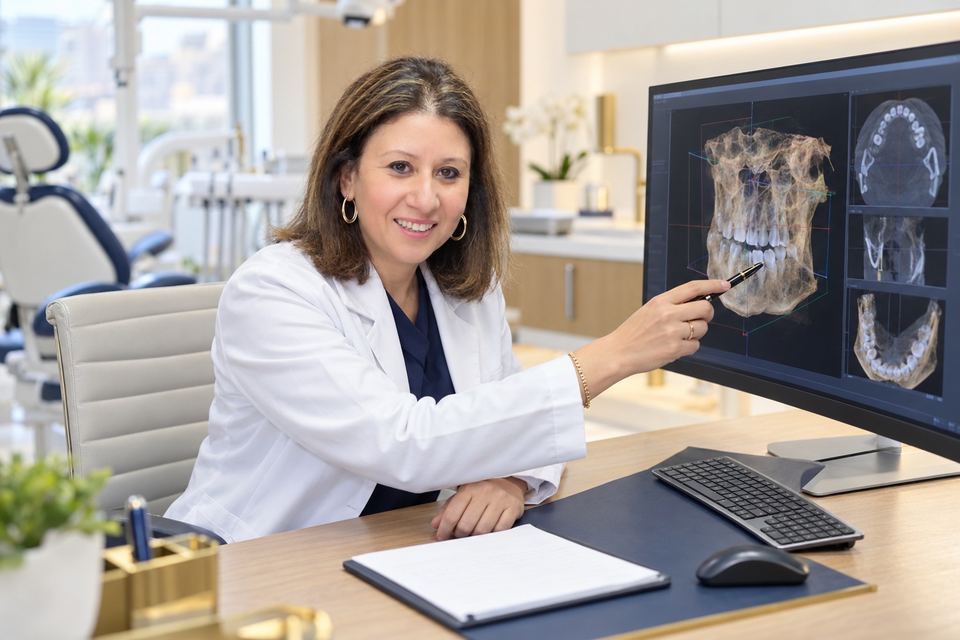
A good assessment for replacing teeth after 50 looks at more than the gaps. Expect the dentist to ask about your medical history and medications, examine your gums and any remaining teeth, check how your current denture fits if you have one, and take X-rays. If implants are being considered, a CBCT scan is usually needed to measure bone height and width and locate nerves and the sinus.
You should leave understanding which options are realistic for you, which are not and why, the approximate timeline of each, and what maintenance each one will need. If something is unclear, ask for it to be written down. A careful plan is never rushed into on the first visit unless there is pain or infection that needs urgent care.
Looking after your teeth whichever option you choose
- Dentures: remove and brush them daily with a soft brush, leave them out at night unless advised otherwise, and have the fit checked regularly.
- Overdentures: clean the denture and the attachments on the implants daily, and expect occasional replacement of the retentive inserts.
- Fixed implant teeth: use interdental brushes or a water flosser under the bridge, and keep professional maintenance visits.
- Bridges: clean under the false tooth with floss threaders or small brushes to protect the supporting teeth.
A note on costs
As a rough guide from public Cairo listings in October 2026: conventional dentures cost about 8,000–20,000 EGP depending on material, single implants about 10,000–30,000 EGP, and full-jaw implant solutions about 40,000–200,000+ EGP. An overdenture on two implants usually sits toward the lower part of the full-jaw range. Your exact cost depends on the examination. Our detailed dental implant cost guide for Cairo explains what drives these numbers.
Next step
The most reliable way to choose is to see your options for your own mouth. At our clinic in Maadi, we examine your gums, bone and any remaining teeth, explain each option including non-surgical ones, and give you a written plan. You are welcome to take it home and discuss it with your family. Book a consultation or message us on WhatsApp with any questions, and see our implants vs bridge vs denture FAQ in the meantime.
Recognise yourself in this?
Send us a message or a photo of your X-ray on WhatsApp. Prof. Nouran will look at your case and give you a clear plan, with no pressure to start.